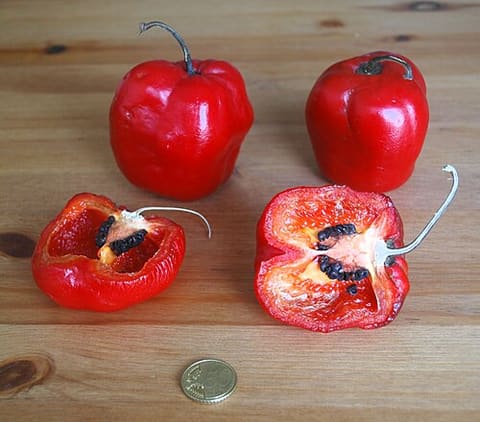
A cornerstone of Peruvian cooking, this South American chilli has thick flesh, an orange colour and medium to hot heat with a rounded fruitiness. It is sold fresh, dried, canned or as a paste, and goes into soups and creamy sauces spooned over meat, fish and vegetables, or adds colour to rice.
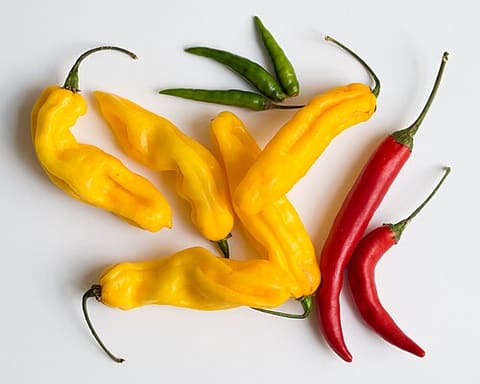
Known in English as the lemon drop pepper, this Peruvian chilli ripens to golden yellow and carries a sharp citrus tang, sometimes likened to lemongrass. Its moderate heat suits salsas, hot sauces and chicken or fish dishes, and it is a common seasoning across Peru.
Grown along Peru's coast, this burgundy-red chilli looks like ají amarillo but is milder, with a sweet, berry-like, lightly smoky taste and floral notes. Dried or turned into paste, it seasons sauces, stews and fish dishes such as the seafood soup parihuela.
A chilli native to the Andes of Peru and Bolivia, belonging to the species Capsicum pubescens. The plant has hairy leaves, and the pepper has thick, juicy flesh in red, orange, yellow or green with distinctive black seeds. It is a staple of Andean cooking.
A hot chilli named after Cayenne in French Guiana, now cultivated in India, East Africa, Mexico and the USA. Usually sold dried and ground, it carries roughly the heat of a serrano and seasons soups, sauces, meat and seafood, and gives many vinegar-based hot sauces their kick.
PDO · AOPProtected Designation of Origin (locally AOP)Hot Pepper
A hand-picked red chilli from the Basque country in the Pyrénées-Atlantiques, with a fruity, smoky scent and moderate heat. It was first used locally to cure ham. Peppers are sold fresh, strung together on cords, or dried and ground into an orange-red powder.
Hungarian ground paprika from the Kalocsa area, made by evenly milling dried red pepper pods. It smells pleasantly of roasted seeds and tastes sweet and fruity, with heat rising with capsaicin content; cooks use it in stews, egg and fish dishes and meat marinades.
Ground paprika from the Szeged district of Hungary, made by milling dried pepper pods into a vivid red powder. Standard grades are sweet and mellow with only mild heat, while hotter types contain more capsaicin; it seasons goulash, stews and meat.
Spanish paprika ground from dried red peppers, grown mainly in Extremadura and Murcia. The drying method sets it apart: in La Vera the peppers are dried over oak smoke, giving a distinctive smoky taste. The peppers themselves arrived from the Americas in the sixteenth century.
PDO · DOPProtected Designation of Origin (locally DOP)Paprika
Smoked paprika from the La Vera valley in Cáceres province, made there since the sixteenth century. After the autumn harvest the peppers are dried and then smoked over oak for about two weeks before milling. It comes sweet, medium or hot, the hot kind going into stews and chorizo.
A small, pointed green serrano chilli native to Tlaola in Puebla, Mexico, grown on terraces by a group of Nahua women. Seedlings are raised under cover and planted out around December, and the peppers are picked by hand in April, some sold fresh.
A long Filipino chilli, also called siling pangsisang or siling espada, that is green when picked and reddens as it ages. It has jalapeño-level heat, much gentler than siling labuyo, and goes into dishes such as sinigang, sisig, pinangat and dinuguan.
Sweet ground paprika from Slovakia, named after the Žitava river valley where the peppers were first grown and now made across the Danubian lowlands. Fully ripe peppers are dried and milled into an intensely orange-red powder coloured by the oil released in grinding.
Small, fiery chillies widely used in Thai and wider Southeast Asian cooking, known in English as bird's eye or Thai chillies. They are only one of many Thai cultivars but the best known. Their flavour is lively and their heat well above that of jalapeños or serranos.
What PDO, PGI and TSG mean
These are the European Union’s protected food names (the UK and Switzerland run matching schemes). A registered name can only go on products made the registered way — so “Parmigiano Reggiano” on a label is a promise about place and method, not just a style.
PDOProtected Designation of OriginProtected Designation of Origin
Every stage — producing the raw material, processing and preparing it — happens in one defined area, following a registered method. The strongest link between a food and its place.
At least one stage of making the food happens in the named area, and its reputation or character comes from that place. Raw materials may come from elsewhere.
Protects a traditional recipe or method rather than a place: it can be made anywhere, as long as the registered method is followed.
On packs you will often see the local abbreviation instead: DOP (Italy, Spain, Portugal), AOP or AOC (France, Switzerland), IGP for PGI, and wine terms such as DOC and DOCG. We show both. Slow Food Presidia and the Ark of Taste are listed too: they mark endangered traditional foods, not legal name protection.