
Eisbein (Berlin cured pork knuckle with sauerkraut and pea purée)
Non-vegetarian
Eisbein
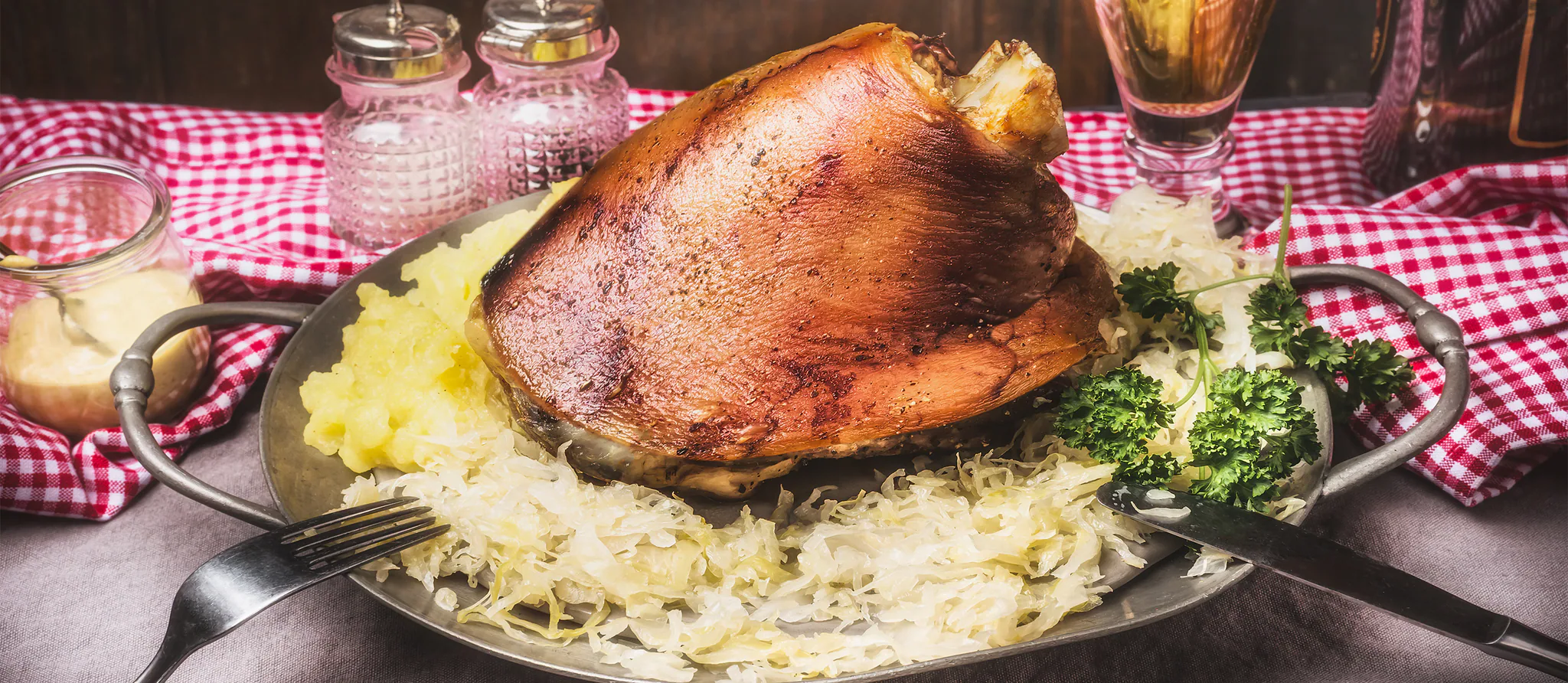
Cured pork knuckle simmered for hours with onion, root vegetables, juniper and allspice until the pink meat slips from the bone under its soft, gelatinous rind. Served the Berlin way with braised sauerkraut, yellow pea purée and sharp mustard.
Eisbein (Berlin cured pork knuckle with sauerkraut and pea purée) is a German main course from Germany, ready in about 3 hours 5 minutes and made with pork knuckle (ham hock, fresh), sauerkraut and dried split peas (yellow or green). It serves 4 and is rated easy to cook.
- Prep
- 20 min
- Cook
- 2 h 45 min
- Total
- 3 h 5 min
- Serves
- 4
- Level
- Easy
- Calories
- 1915
Main ingredients
Ingredients
For the knuckles
For the sauerkraut
For the pea purée
To serve
Method
Knuckles
2 h 50 minStep 1
Put the knuckles in a large pot, cover with cold water and bring slowly to the boil. Skim off the foam, then add the onion (opens in a new tab), carrot (opens in a new tab), celeriac (opens in a new tab), garlic (opens in a new tab), bay leaves (opens in a new tab), allspice (opens in a new tab), juniper (opens in a new tab), coriander, peppercorns (opens in a new tab) and marjoram (opens in a new tab). Do not add salt: the cured meat is salty enough.
- 20 min
- medium-high heat
- Stockpot / large pot (opens in a new tab)
- Slotted spoon (opens in a new tab)
Step 2
Simmer very gently, partly covered, for 2½ hours, until the meat is very tender and a fork slides easily into it near the bone.
- 150 min
- low heat
Food safety: Cook fresh pork to at least 71 °C (160 °F) in the centre for minced or stuffed meat, 63 °C (145 °F) with a 3-minute rest for whole cuts.
Pea purée
1 hStep 3
Meanwhile cook the split peas in a saucepan (opens in a new tab) with fresh water to cover by 3 cm (or some of the knuckle stock for more flavour) for 45–60 minutes until falling apart. Fry the onion (opens in a new tab) in the butter (opens in a new tab) until golden, add to the peas and blend to a thick purée. Season with salt if needed.
- 60 min
- medium-low heat
- Saucepan (opens in a new tab)
- Hand (stick) blender (opens in a new tab)
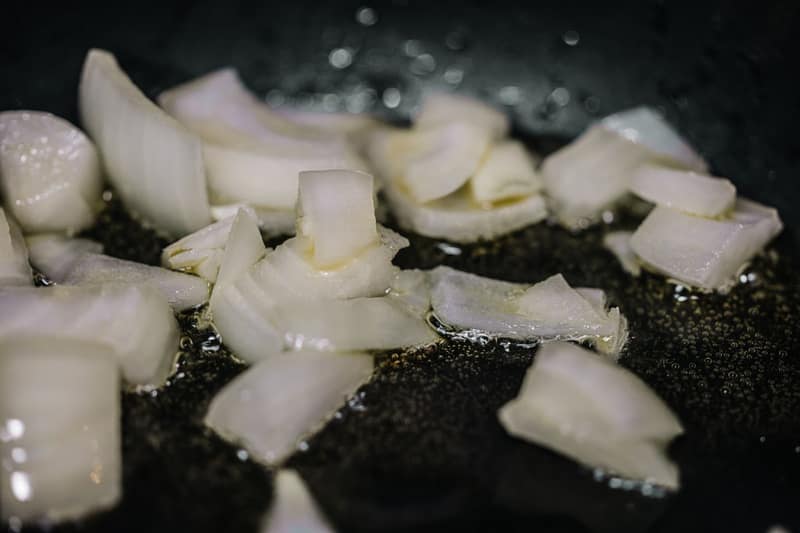
How it looks · Photo: Magda Ehlers on Pexels
Sauerkraut
40 minStep 4
For the sauerkraut (opens in a new tab), soften the chopped onion (opens in a new tab) in the lard (opens in a new tab), add the sauerkraut, juniper (opens in a new tab), bay leaf (opens in a new tab), sugar (opens in a new tab) and a ladle of the knuckle stock. Cover and braise for 40 minutes, stirring occasionally.
- 40 min
- low heat
- Saucepan (opens in a new tab)
To serve
5 minStep 5
Lift out the knuckles, drain and serve whole or halved on a bed of sauerkraut (opens in a new tab) with the pea purée and plenty of mustard.
- 5 min
At a glance
1 · Knuckles in a pot
 Pork knuckle (ham hock, fresh)
 Onion
 Carrot
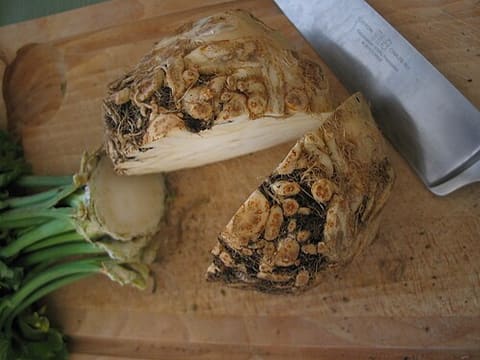 Celeriac
 Garlic
 Bay leaves
 Allspice
 Juniper berries
 Coriander seeds
 Black peppercorns
 Dried marjoram
then cook
2 · Pea purée in a pan
 Dried split peas (yellow or green)
- Onion
 Butter
 Salt
then soften
3 · Sauerkraut in a pot
 Sauerkraut
 Lard
- Onion
- Juniper berries
- Bay leaves
 Sugar
then lift
4 · To serve in a bowl
 Prepared mustard
About this dish
- Origin
- Berlin, northern and eastern Germany, Germany · Well documentedUnlike the roasted, crackling Bavarian Schweinshaxe, Eisbein is cured (gepökelt) and boiled, which keeps it pale and moist. The name is thought to come from the bone once being used to make ice skates.More food from Germany
Germany - Dish
- Lunch · Dinner · Main courses
- Cooking method
- Simmered, Braised, Boiled
- Taste
- savoury, salty, sour, rich
- Diet
- No gluten ingredients · No nut ingredients · High-proteinWorked out from the ingredients. How labels work
All labels
Non-vegetarian · No gluten ingredients · Egg-free · No nut ingredients · Alcohol-free · Beef-free · High-protein - Good for
- One-pot · Budget-friendly
- Cook more with
- Pork knuckle (ham hock, fresh) · Sauerkraut · Dried split peas (yellow or green) · Onion · Carrot · Garlic
- Techniques
- Boiling · Simmering · Braising · Stock making
Allergens
- Contains: Milkfrom butter
- Contains: Mustardfrom prepared mustard
- Contains, can be adapted: Celeryfrom celeriac
- May contain: Sulphitesfrom prepared mustard
Based on typical versions of these ingredients and not verified allergen-free. Brands differ and cross-contact happens, so always check labels. For severe allergies, follow your clinician’s advice.
Nutrition
1915 kcal per serving
Estimated1 serving ≈ 1024 g · recipe makes 4
Where the energy comes from
- Protein 26%
- Carbohydrate 15%
- Fat 59%
| Nutrient | Per serving | Per 100 g* |
|---|---|---|
| Energy | 1915 kcal | 187 kcal |
| Protein | 124.4 g | 12.1 g |
| Carbohydrate | 69.1 g | 6.7 g |
| Net carbohydrate | 43.2 g | 4.2 g |
| Sugars | 12.1 g | 1.2 g |
| Added sugars | 1 g | 0.1 g |
| Fibre | 25.9 g | 2.5 g |
| Fat | 125.6 g | 12.3 g |
| Saturated fat | 44.7 g | 4.4 g |
| Trans fat | — | — |
| Cholesterol | 449 mg | 44 mg |
| Sodium | 2543 mg | 248 mg |
| Salt equivalent | 6.4 g | 0.6 g |
Vitamins & minerals per serving
- Potassium
- 3063 mg
- Calcium
- 242 mg
- Iron
- 13.7 mg
- Magnesium
- 205 mg
- Vitamin A (RAE)
- 323 µg
- Vitamin C
- 44 mg
- Vitamin D
- 10.4 µg
- Vitamin B12
- 4.5 µg
- Folate (DFE)
- 113 µg
How these numbers were made
- Calculated from USDA FoodData Central (SR Legacy) per-100 g values and the listed quantities.
- *Per 100 g of combined raw ingredients; the cooked dish may weigh more or less.
- Optional ingredients are not included: celeriac.
- Not counted (tiny amounts or “to taste”): juniper berries, juniper berries.
- Pork knuckle (ham hock, fresh): Fresh pork shoulder, lean and fat (FDC 167843) used as a stand-in; a fresh knuckle has more skin, collagen and bone.
- Dried split peas (yellow or green): Raw green split peas (FDC 172428); yellow and green split peas are nutritionally near-identical.
- “—” means the value isn’t known for enough of the ingredients; it is never zero by default.
- Values are estimates for guidance, not for medical dosing. U.S. Department of Agriculture, Agricultural Research Service. FoodData Central, 2019. fdc.nal.usda.gov.
Good to know
Tips
- To cure your own: dissolve 70 g curing salt (Pökelsalz) and 20 g sugar in 1 l water with bay and juniper, submerge fresh knuckles and refrigerate for 5–7 days, turning daily, then rinse before cooking.
- Strain and keep the stock: it makes an excellent base for pea or lentil soup.
Common mistakes
- Boiling hard, which toughens the meat; it should barely tremble.
- Salting the water or the sauerkraut before tasting.
Serve with
- Serve with boiled potatoes as well as the pea purée, a cold Berliner pilsner and a schnapps.

Food safety
- Cook fresh pork to at least 71 °C (160 °F) in the centre for minced or stuffed meat, 63 °C (145 °F) with a 3-minute rest for whole cuts.
- Curing salt contains nitrite and must be used only in the stated amounts and kept away from children; it is not a substitute for ordinary salt.
- Cool leftovers within 2 hours, refrigerate and eat within 3 days; reheat until steaming hot throughout.
Storage
- Meat keeps 3 days refrigerated in some of its stock; the pea purée and sauerkraut keep 4 days.
Reheating
- Warm the knuckle gently in its stock until piping hot.
Variations
- Eisbein in Aspik: The cooked meat pulled from the bone and set in its own jellied stock, served cold.
- Golonka (Poland) (Poland): Similar knuckle simmered and often finished in the oven, served with horseradish and mustard.
Original editorial recipe · FriendsPantry editorial · source: TasteAtlas (dish facts) · Not yet independently reviewed · Added
Recipe DNA
How this dish is built
Built from the recipe’s own sections. Each band’s width is its share of the dish by weight. Choose a component to see what it does.
Reviews & corrections
Reviews come from signed-in cooks and appear after a moderator checks them. We never show made-up ratings.
You might also like
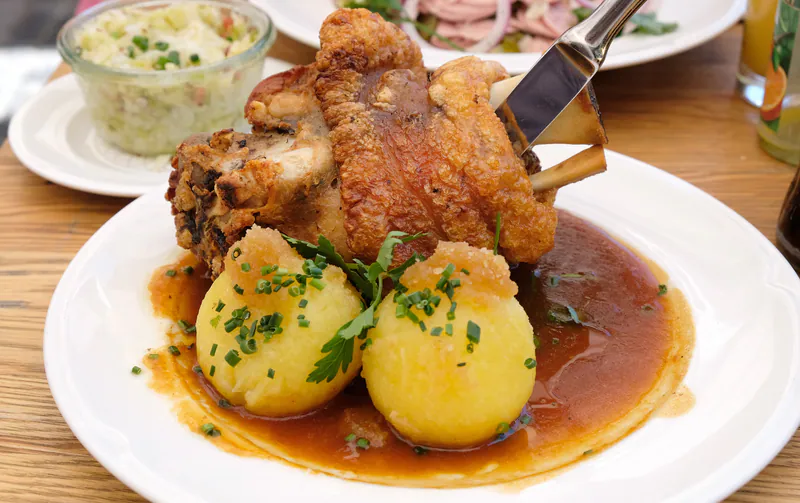
Schweinshaxe (Bavarian roast pork knuckle)
 German · 3 h 55 min · 1520 kcal
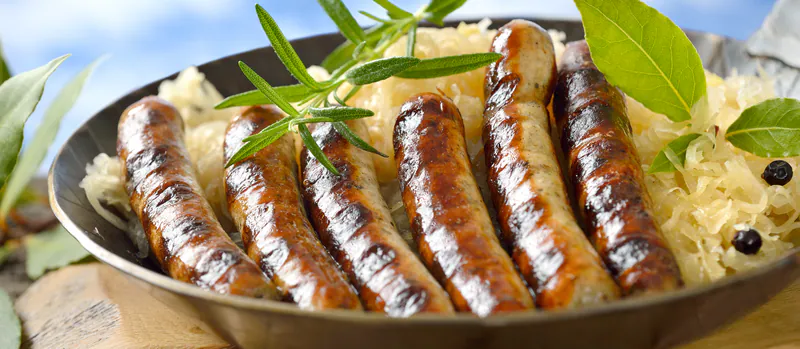
Homemade Franconian bratwurst
German · 3 h 35 min · 695 kcal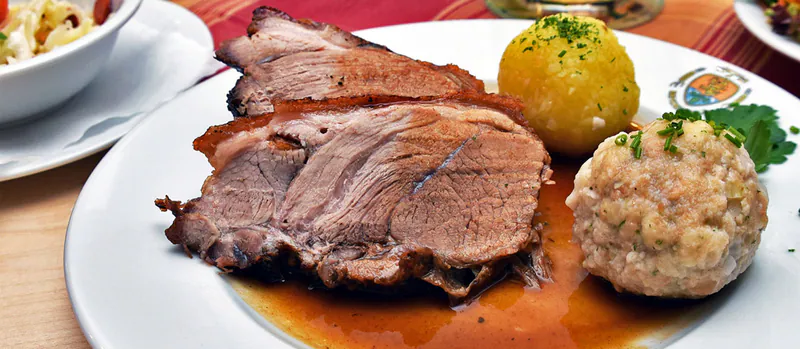
Schweinebraten (Bavarian roast pork)
German · 3 h 35 min · 713 kcal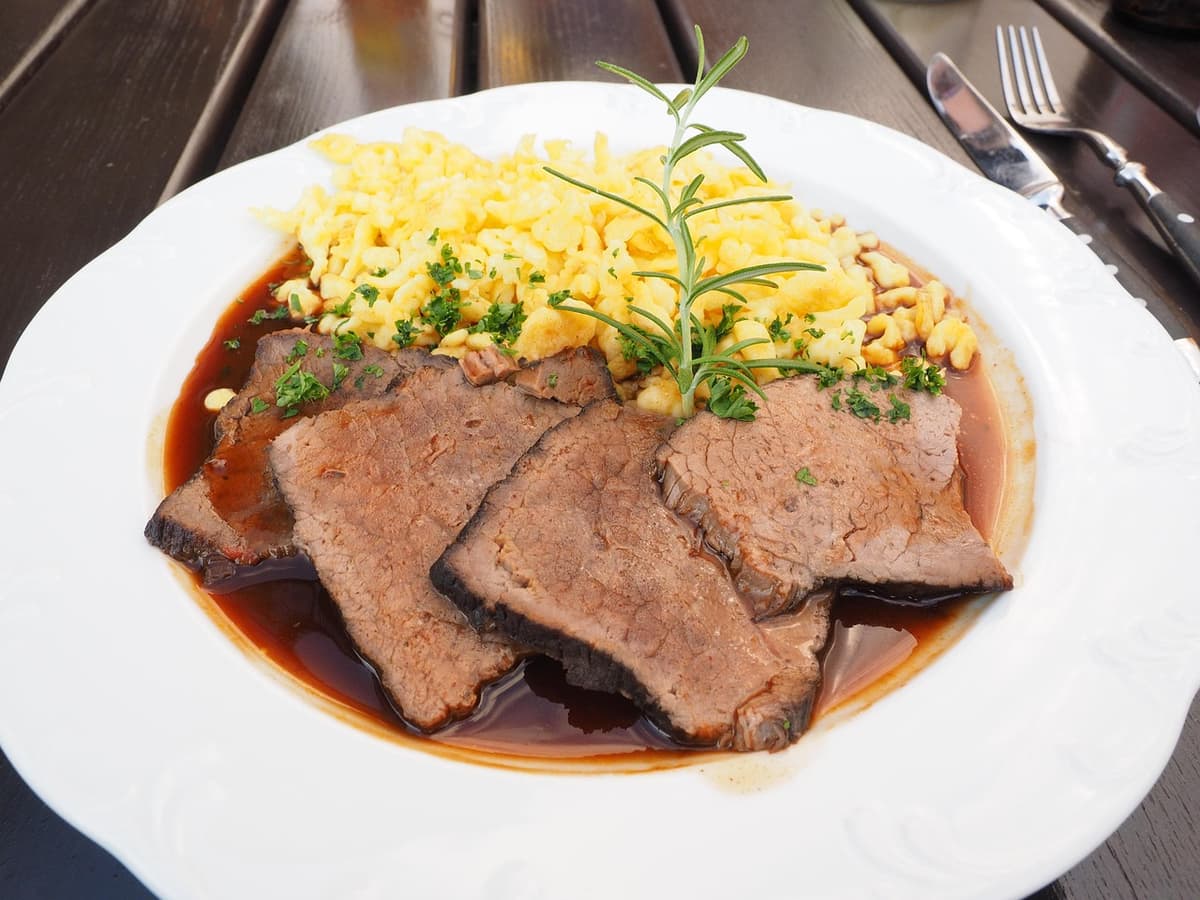
Sauerbraten
German · 3 h 40 min · 441 kcal