
Rupjmaize (Latvian wholegrain rye bread)
Vegetarian
Rupjmaize
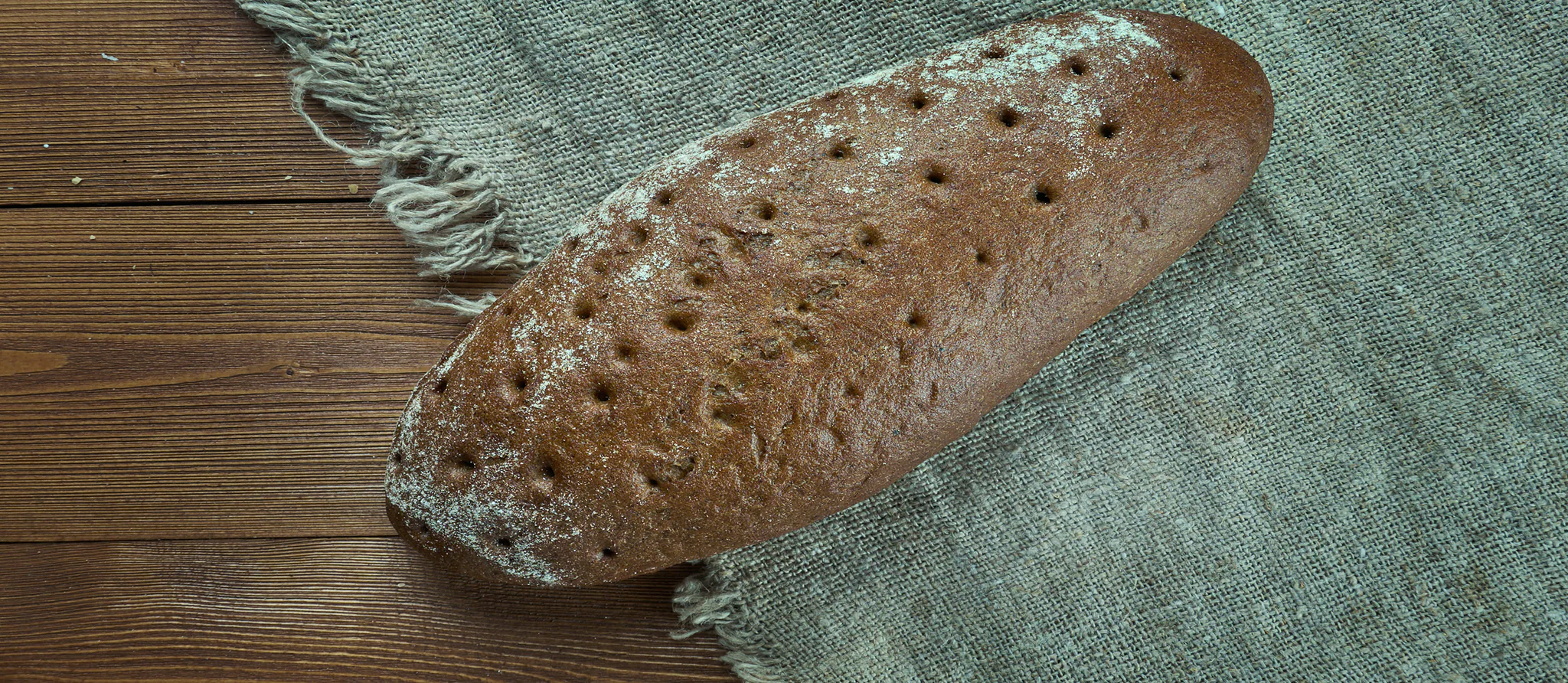
A dark, heavy loaf of coarse wholegrain rye that is scalded with malt and leavened with sourdough, giving it the sweet-and-sour taste Latvians love. It is shaped into a long hearth loaf and kept moist for days by the scald.
Rupjmaize (Latvian wholegrain rye bread) is a Latvian bread, ready in about 4 hours 55 minutes and made with rye flour, caraway seeds and sourdough starter. It serves 16 and is rated intermediate to cook.
- Prep
- 40 min
- Cook
- 1 h 15 min
- Rest
- 3 h
- Total
- 4 h 55 min
- Serves
- 16
- Level
- Intermediate
- Calories
- 181
Plus an overnight scald and leaven, and 12 hours' resting before slicing.
Main ingredients
Ingredients
For the scald
For the leaven
For the dough
For the top
For the tin
Method
Scald
10 minStep 1
The evening before, mix the 200 g rye flour (opens in a new tab), malt and caraway (opens in a new tab) in a bowl and whisk in the boiling water to a smooth, thick porridge. Cover, wrap the bowl in a towel to keep it warm for 3–4 hours, then leave overnight.
Holding the scald warm (ideally around 60 °C) lets the malt enzymes turn starch into sugar, which gives rupjmaize its sweetness.
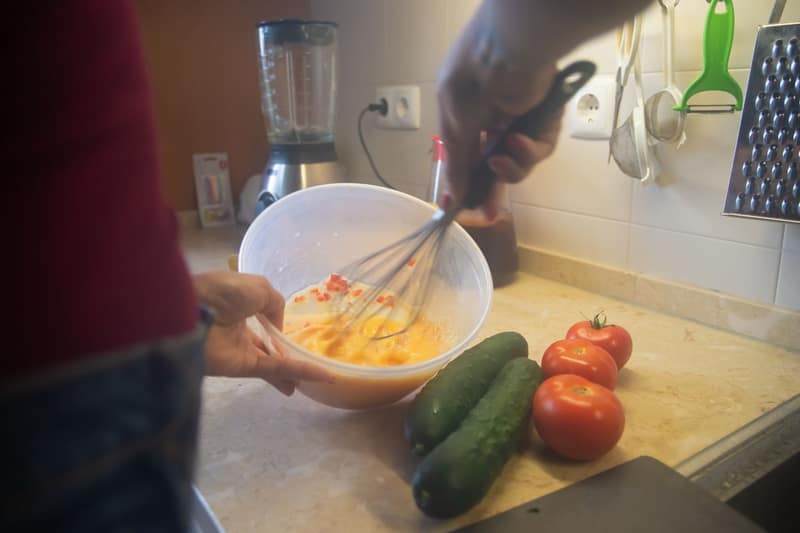
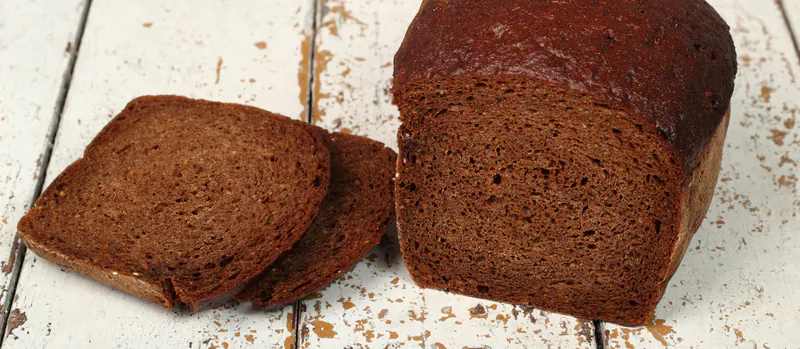
How it looks · Photo: Kampus Production on Pexels
Leaven
5 minStep 2
At the same time, stir the starter with 150 g rye flour (opens in a new tab) and the lukewarm water to make the leaven. Cover and leave at room temperature for 10–12 hours until bubbly.
- 5 min
Dough
10 minStep 3
Next morning, combine the scald, leaven, remaining rye flour (opens in a new tab), buttermilk (opens in a new tab), sugar (opens in a new tab), salt and yeast. Mix with a wet hand or spoon for 8–10 minutes to a sticky, clay-like paste; rye dough is never kneaded like wheat dough.
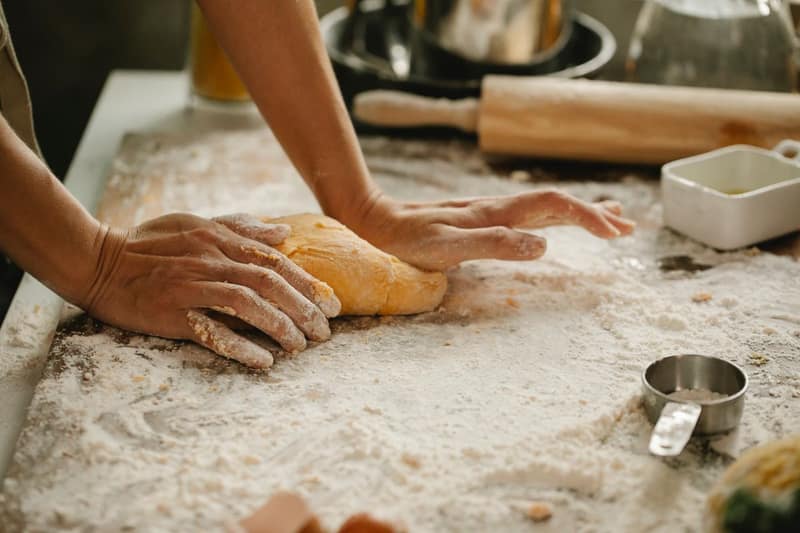
How it looks · Photo: Klaus Nielsen on Pexels Step 4
Cover and leave in a warm place for about 2 hours until risen by half and dotted with holes on top.
Tin
1 h 25 minStep 5
With wet hands, shape the dough into a long oval loaf and set it in an oiled loaf tin (opens in a new tab) or on a lined baking tray. Smooth the top with water, sprinkle with caraway (opens in a new tab) and leave to prove for about 1 hour, until small cracks appear on the surface.
How it looks · Photo: Klaus Nielsen on Pexels Step 6
Bake at 230 °C for 15 minutes, then lower to 190 °C and bake for another 60 minutes, until the loaf sounds hollow when tapped underneath. Brush the hot crust with water for a soft shine.
- 75 min
- 230°C · then 190 °C
- Oven (opens in a new tab)
Step 7
Cool on a rack, then wrap in a cloth and leave for at least 12 hours before slicing, so the crumb sets.
At a glance
1 · Scald in a bowl
 Rye flour
- Barley malt powder
 Caraway seeds
then stir
2 · Leaven in a bowl
 Sourdough starter
- Rye flour
then morning
3 · Dough in a bowl
- Rye flour
 Buttermilk
 Sugar
 Salt
 Instant yeast
then shape
4 · Tin in a bowl
 Neutral vegetable oil
About this dish
- Origin
- Latvia · Well documentedRye has been Latvia's bread grain for centuries. Rupjmaize ('coarse bread') was traditionally baked weekly in the farmhouse oven on maple or calamus leaves, which flavoured the base; today it is a protected traditional speciality and still the everyday bread.Also popular in Lithuania, EstoniaMore food from Latvia
Latvia - Dish
- Breakfast · Lunch · Dinner · Breads & flatbreads
- Cooking method
- Fermented, Oven-baked
- Taste
- sweet & savoury, sour, earthy, aromatic / warmly spiced
- Diet
- Vegetarian (lacto-ovo) · No nut ingredients · High-fibreWorked out from the ingredients. How labels work
All labels
Vegetarian (lacto-ovo) · Eggetarian · Lacto-vegetarian · Pescatarian · Flexitarian-friendly · Egg-free · No nut ingredients · Alcohol-free · Pork-free · Beef-free · High-fibre · Low-fat · DASH-style - Good for
- Make-ahead · Freezer-friendly
- Cook more with
- Rye flour · Caraway seeds · Sourdough starter · Barley malt powder · Buttermilk · Sugar
- Techniques
- Baking · Boiling · Kneading · Fermentation
Allergens
- Contains: Milkfrom buttermilk
- Contains: Wheatfrom rye flour, sourdough starter
- Contains: Glutenfrom rye flour, barley malt powder, sourdough starter
Based on typical versions of these ingredients and not verified allergen-free. Brands differ and cross-contact happens, so always check labels. For severe allergies, follow your clinician’s advice.
Nutrition
181 kcal per serving
Estimated1 serving ≈ 81 g · recipe makes 16
Where the energy comes from
- Protein 11%
- Carbohydrate 81%
- Fat 8%
| Nutrient | Per serving | Per 100 g |
|---|---|---|
| Energy | 181 kcal | 222 kcal |
| Protein | 5.3 g | 6.5 g |
| Carbohydrate | 37.4 g | 46.1 g |
| Net carbohydrate | 32.1 g | 39.5 g |
| Sugars | 2.7 g | 3.3 g |
| Added sugars | 1.9 g | 2.3 g |
| Fibre | 5.3 g | 6.6 g |
| Fat | 1.6 g | 2 g |
| Saturated fat | 0.2 g | 0.2 g |
| Trans fat | — | — |
| Cholesterol | 0 mg | 0 mg |
| Sodium | 302 mg | 372 mg |
| Salt equivalent | 0.8 g | 0.9 g |
Vitamins & minerals per serving
- Potassium
- 180 mg
- Calcium
- 23 mg
- Iron
- 1.3 mg
- Magnesium
- 31 mg
- Vitamin A (RAE)
- 1 µg
- Vitamin C
- 0 mg
- Vitamin D
- 0 µg
- Vitamin B12
- 0 µg
- Folate (DFE)
- 20 µg
How these numbers were made
- Calculated from USDA FoodData Central (SR Legacy) per-100 g values and the listed quantities.
- Optional ingredients are not included: instant yeast, caraway seeds.
- Sourdough starter: Modelled as a 100%-hydration starter: equal weights of flour and water, so half of white flour's values per gram.
- “—” means the value isn’t known for enough of the ingredients; it is never zero by default.
- Values are estimates for guidance, not for medical dosing. U.S. Department of Agriculture, Agricultural Research Service. FoodData Central, 2019. fdc.nal.usda.gov.
Good to know
Tips
- Slice thinly with a serrated knife; rupjmaize keeps a week in a cloth bag and gets better over the first few days.
- Bake on a few clean cabbage or maple leaves on the tray for a more traditional base.
Common mistakes
- Cutting the loaf warm, which leaves a gummy, sticky crumb.
- Adding extra flour to make the dough easier to handle; rye dough should be sticky.
Serve with
- With butter and smoked fish, cold cuts, or a strong, pungent cheese.
- Toasted with garlic as a beer snack, or crumbled into rupjmaizes kārtojums, the layered rye bread dessert.
Storage
- Keeps 7 days wrapped in a cloth at room temperature; freeze sliced for up to 3 months.
Variations
- Saldskābmaize: Latvian 'sweet-sour bread', made with finer rye flour and more sugar for a softer, sweeter loaf.
- Juoda duona (Lithuania): Lithuania's black rye bread, a close cousin also built on a scald and sourdough.
Original editorial recipe · FriendsPantry editorial · source: TasteAtlas (dish facts) · Not yet independently reviewed · Added
Recipe DNA
How this dish is built
Built from the recipe’s own sections. Each band’s width is its share of the dish by weight. Choose a component to see what it does.
Structure
For the dough
- Rye flour350 g
- Buttermilk100 ml · 103 g
- Sugar30 g
- Salt12 g
- Instant yeast (optional)3 g
Reviews & corrections
Reviews come from signed-in cooks and appear after a moderator checks them. We never show made-up ratings.
You might also like
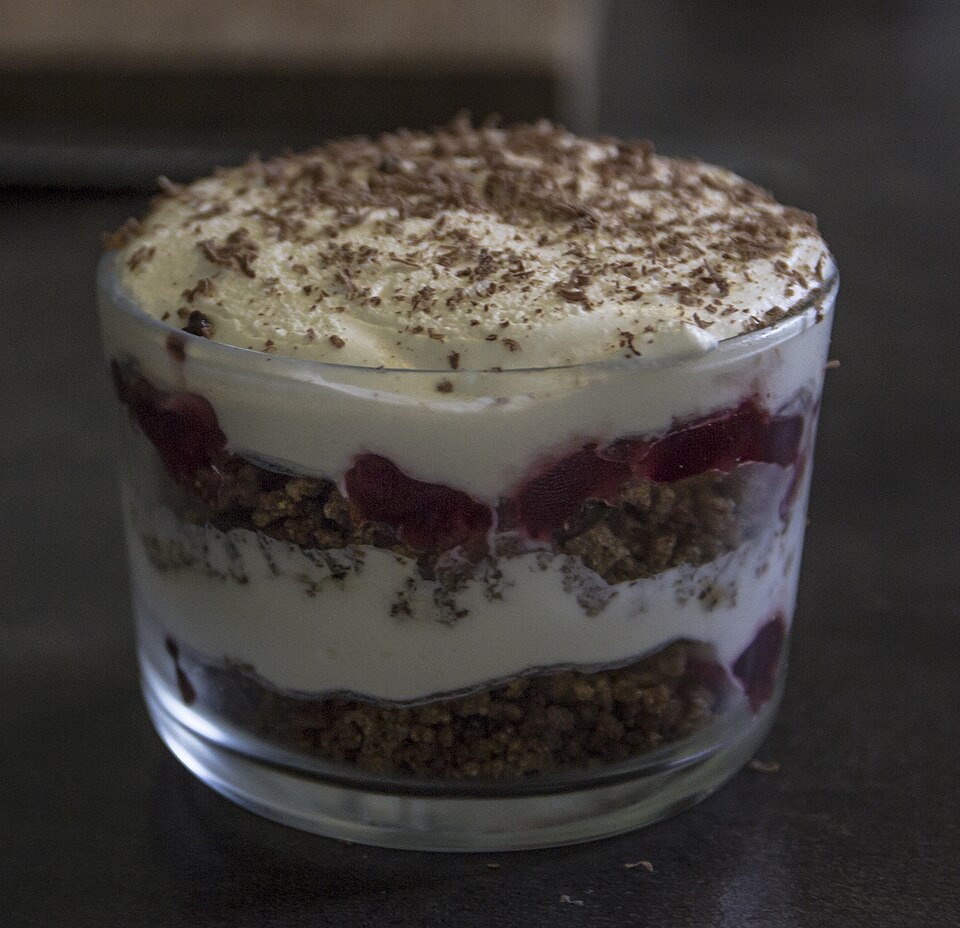
Rupjmaizes kārtojums
 Latvian · 1 h 23 min · 382 kcal · Vegetarian
Juoda duona (Lithuanian black rye bread)
 Lithuanian · 4 h 30 min · 175 kcal · Vegan
Pelēkie zirņi ar speķi
Latvian · 1 h 25 min · 492 kcal
Sklandrausis
Latvian · 1 h 35 min · 211 kcal · Contains egg