
Pan gallego (Galician sourdough bread)
Vegetarian
Pan galego
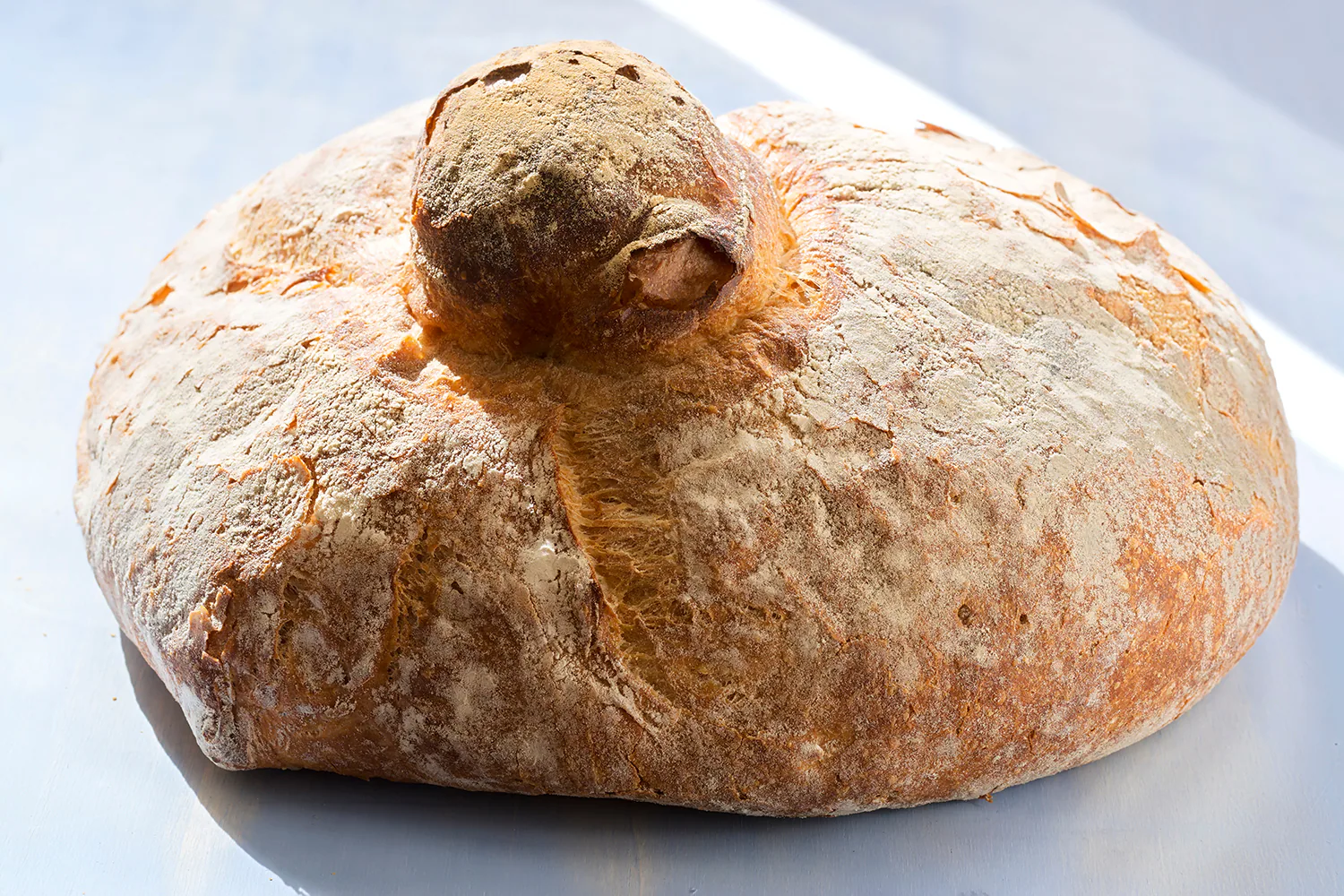
A very wet, long-fermented sourdough loaf with a thick, crackling crust and an open, springy crumb full of irregular holes. This home version shapes it as a round with the topknot (moña) typical of many Galician bakeries.
Pan gallego (Galician sourdough bread) is a Spanish bread from Spain, ready in about 8 hours 15 minutes and made with bread flour, water and sourdough starter. It serves 10 and is rated advanced to cook.
- Prep
- 30 min
- Cook
- 45 min
- Rest
- 7 h
- Total
- 8 h 15 min
- Serves
- 10
- Level
- Advanced
- Calories
- 198
Rest includes bulk rise, final proof and cooling; an optional overnight proof in the fridge adds 8–12 hours.
Main ingredients
Method
Step 1
Mix both flours with 350 ml of the water until no dry flour remains. Cover and rest for 45 minutes (autolyse).
Step 2
Add the starter, salt and remaining water and squeeze and fold the dough with a wet hand until fully absorbed and the dough tightens, about 5 minutes.
- 6 min
Step 3
Bulk-ferment in a warm place (24–26 °C) for about 4 hours, doing a set of stretch-and-folds every 30 minutes for the first 2 hours. The dough should grow by about 50%, feel airy and show bubbles.
Wet your hands before each set of folds so the sticky dough does not cling.
Step 4
Turn the dough onto a floured surface. Pinch off a small piece (about 80 g) and set aside. Shape the rest into a tight round. Roll the small piece into a ball, press it firmly onto the top of the loaf to make the moña, and push your floured thumb down through its centre to anchor it.
Step 5
Place the loaf top-down in a well-floured proofing basket (opens in a new tab). Proof for 1½–2 hours at room temperature, or cover and refrigerate overnight for more flavour.
Step 6
Heat the oven (opens in a new tab) with a lidded cast-iron pot inside to 250 °C for 45 minutes. Turn the loaf out onto baking paper, lower it into the pot, cover and bake for 25 minutes.
Food safety: The pot is extremely hot: use thick oven gloves and lower the loaf in on the paper.
Step 7
Remove the lid, lower the oven (opens in a new tab) to 230 °C and bake for another 20–25 minutes until the crust is deep brown and the loaf sounds hollow when tapped. Cool on a rack for at least 1 hour before slicing.
- 22 min
- 230°C
- Cooling rack (opens in a new tab)
About this dish
- Origin
- Galicia, Spain · Well documentedTraditional Galician bakers use local soft wheat (trigo del país), sourdough and a lot of water; Pan Galego has PGI status, and towns such as Cea are famous for their loaves.More food from Spain
Spain - Dish
- Breakfast · Lunch · Dinner · Breads & flatbreads
- Cooking method
- Oven-baked, Fermented
- Taste
- sour, nutty, mild
- Diet
- Vegan · Dairy-free · No nut ingredientsWorked out from the ingredients. How labels work
All labels
Vegan · Plant-based · Vegetarian (lacto-ovo) · Eggetarian · Lacto-vegetarian · Ovo-vegetarian · Pescatarian · Flexitarian-friendly · Dairy-free · Egg-free · No nut ingredients · No added sugar · Alcohol-free · Pork-free · Beef-free · Low-fat · DASH-style - Good for
- Make-ahead · Freezer-friendly
- Cook more with
- Bread flour · Sourdough starter · Whole-wheat flour
- Techniques
- Baking · Fermentation
Allergens
- Contains: Wheatfrom bread flour, whole-wheat flour, sourdough starter
- Contains: Glutenfrom bread flour, whole-wheat flour, sourdough starter
Based on typical versions of these ingredients and not verified allergen-free. Brands differ and cross-contact happens, so always check labels. For severe allergies, follow your clinician’s advice.
Nutrition
198 kcal per serving
Estimated1 serving ≈ 101 g · recipe makes 10
Where the energy comes from
- Protein 14%
- Carbohydrate 82%
- Fat 4%
| Nutrient | Per serving | Per 100 g* |
|---|---|---|
| Energy | 198 kcal | 196 kcal |
| Protein | 6.6 g | 6.5 g |
| Carbohydrate | 40.1 g | 39.7 g |
| Net carbohydrate | 38.3 g | 37.9 g |
| Sugars | 0.2 g | 0.2 g |
| Added sugars | 0 g | 0 g |
| Fibre | 1.8 g | 1.7 g |
| Fat | 0.9 g | 0.9 g |
| Saturated fat | 0.1 g | 0.1 g |
| Trans fat | — | — |
| Cholesterol | 0 mg | 0 mg |
| Sodium | 389 mg | 386 mg |
| Salt equivalent | 1 g | 1 g |
Vitamins & minerals per serving
- Potassium
- 69 mg
- Calcium
- 13 mg
- Iron
- 2.4 mg
- Magnesium
- 20 mg
- Vitamin A (RAE)
- 0 µg
- Vitamin C
- 0 mg
- Vitamin D
- 0 µg
- Vitamin B12
- 0 µg
- Folate (DFE)
- 146 µg
How these numbers were made
- Calculated from USDA FoodData Central (SR Legacy) per-100 g values and the listed quantities.
- *Per 100 g of combined raw ingredients; the cooked dish may weigh more or less.
- Sourdough starter: Modelled as a 100%-hydration starter: equal weights of flour and water, so half of white flour's values per gram.
- “—” means the value isn’t known for enough of the ingredients; it is never zero by default.
- Values are estimates for guidance, not for medical dosing. U.S. Department of Agriculture, Agricultural Research Service. FoodData Central, 2019. fdc.nal.usda.gov.
Good to know
Tips
- If 80% hydration is hard to handle, start with 370 ml water and work up as you gain confidence.
Common mistakes
- Cutting the loaf hot — the crumb is still setting and turns gummy.
Serve with
- Serve with pulpo a la gallega, caldo gallego or simply with olive oil and Galician cheese such as tetilla.
Storage
- Keeps 3–4 days wrapped in a cloth; freeze sliced for up to 3 months.
Reheating
- Refresh a whole or half loaf in a 200 °C oven for 8–10 minutes.
Variations
- Bolo or hogaza: A large rustic round loaf with a cracked top and no topknot.
- Pan de Cea: An elongated, flattened loaf with a central split, from the town of Cea in Ourense, with its own PGI.
Original editorial recipe · FriendsPantry editorial · source: TasteAtlas (dish facts) · Not yet independently reviewed · Added
Recipe DNA
How this dish is built
Grouped by each ingredient’s role in the dish. Each band’s width is its share of the dish by weight. Choose a component to see what it does.
Reviews & corrections
Reviews come from signed-in cooks and appear after a moderator checks them. We never show made-up ratings.
You might also like
Pulpo a la gallega
 Spanish · 1 h 20 min · 342 kcal
Irish soda bread
 Irish · 1 h 20 min · 225 kcal · Vegetarian
Sourdough country loaf (pain au levain)
 French · 22 h 55 min · 141 kcal · Vegan
Wholegrain sourdough tin loaf
International · 19 h 15 min · 120 kcal · Vegetarian