
Grissini torinesi
Vegetarian
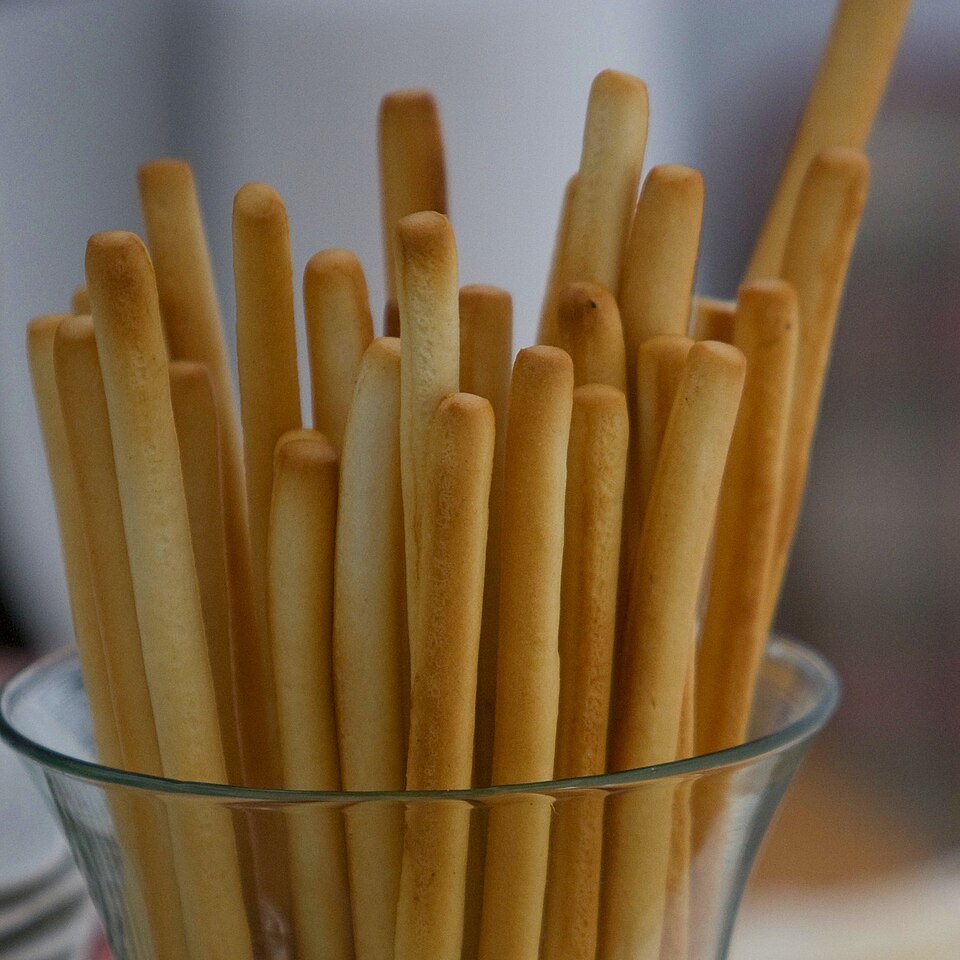
Hand-stretched, knobbly Turin breadsticks made with olive oil and a little semolina — snappy, golden and nothing like the boxed kind.
Grissini torinesi is an Italian bread from Italy, ready in about 2 hours 18 minutes and made with bread flour and olive oil. It serves 24 and is rated easy to cook.
- Prep
- 30 min
- Cook
- 18 min
- Rest
- 1 h 30 min
- Total
- 2 h 18 min
- Serves
- 24
- Level
- Easy
- Calories
- 55
Main ingredients
Method
Step 1
Mix the flour, water, olive oil (opens in a new tab), yeast and salt and knead for 8–10 minutes to a smooth, soft dough.
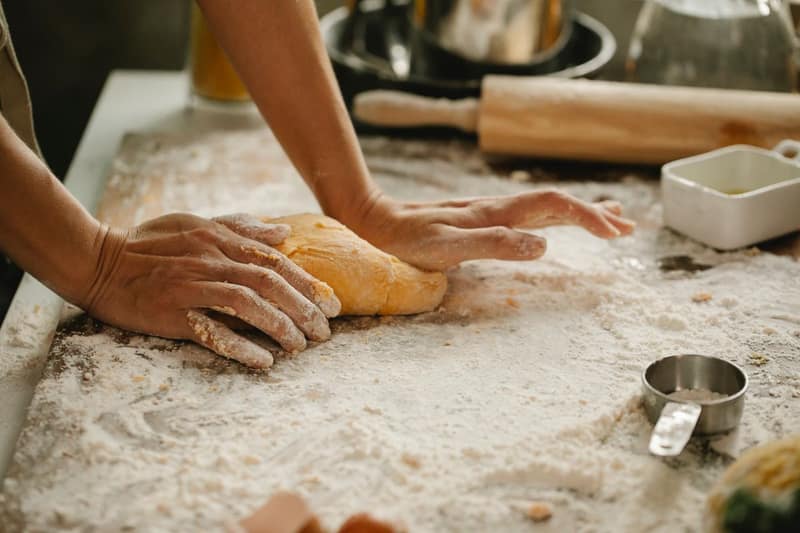
How it looks · Photo: Klaus Nielsen on Pexels Step 2
Pat into a long rectangle about 1 cm thick on an oiled surface, brush the top with oil, cover and rest about 1 hour until puffy.
Step 3
Heat the oven (opens in a new tab) to 200 °C (fan 180 °C). Scatter semolina (opens in a new tab) (and sesame (opens in a new tab) or rosemary (opens in a new tab), if using) over the dough. Cut across into strips 1.5 cm wide with a bench scraper (opens in a new tab).
How it looks · Photo: Klaus Nielsen on Pexels Step 4
Pick up each strip by the ends and stretch it gently to the width of your baking tray, letting it twist and stay uneven. Lay them on lined trays 1 cm apart and rest 15 minutes.
Step 5
Bake 15–18 minutes until evenly golden and crisp right through — they firm up further as they cool.
- 18 min
- 200°C · fan 180 °C
- Oven (opens in a new tab)
At a glance
 Bread flour
 Olive oil
 Instant yeast
 Salt
 Semolina
 Sesame seeds
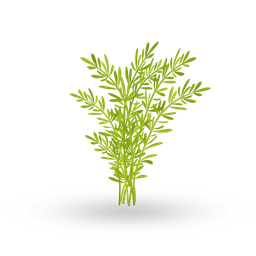 Rosemary (fresh)
About this dish
- Origin
- Piedmont (Turin), Italy · Well documentedMore food from Italy
Italy - Dish
- Snack · Dinner · Breads & flatbreads · Appetizers & starters · Finger food
- Cooking method
- Oven-baked
- Taste
- savoury, nutty, salty
- Diet
- Vegan · Dairy-free · No nut ingredients · Low-carbWorked out from the ingredients. How labels work
All labels
Vegan · Plant-based · Vegetarian (lacto-ovo) · Eggetarian · Lacto-vegetarian · Ovo-vegetarian · Pescatarian · Flexitarian-friendly · Dairy-free · Egg-free · No nut ingredients · No added sugar · Alcohol-free · Pork-free · Beef-free · Low-carb · DASH-style - Good for
- Make-ahead · Portable / lunchbox · Child-friendly
- Cook more with
- Bread flour · Instant yeast · Semolina
Allergens
- Contains: Wheatfrom bread flour, semolina
- Contains: Glutenfrom bread flour, semolina
- Contains, can be adapted: Sesamefrom sesame seeds
Based on typical versions of these ingredients and not verified allergen-free. Brands differ and cross-contact happens, so always check labels. For severe allergies, follow your clinician’s advice.
Nutrition
55 kcal per serving
Calculated1 serving ≈ 16 g · recipe makes 24
Where the energy comes from
- Protein 11%
- Carbohydrate 65%
- Fat 23%
| Nutrient | Per serving | Per 100 g |
|---|---|---|
| Energy | 55 kcal | 348 kcal |
| Protein | 1.5 g | 9.5 g |
| Carbohydrate | 8.8 g | 55.7 g |
| Net carbohydrate | 8.5 g | 53.5 g |
| Sugars | — | — |
| Added sugars | 0 g | 0 g |
| Fibre | 0.3 g | 2.2 g |
| Fat | 1.4 g | 9.2 g |
| Saturated fat | 0.2 g | 1.3 g |
| Trans fat | — | — |
| Cholesterol | 0 mg | 0 mg |
| Sodium | 81 mg | 513 mg |
| Salt equivalent | 0.2 g | 1.3 g |
Vitamins & minerals per serving
- Potassium
- 15 mg
- Calcium
- 3 mg
- Iron
- 0.5 mg
- Magnesium
- 4 mg
- Vitamin A (RAE)
- 0 µg
- Vitamin C
- 0 mg
- Vitamin D
- 0 µg
- Vitamin B12
- 0 µg
- Folate (DFE)
- 37 µg
How these numbers were made
- Calculated from USDA FoodData Central (SR Legacy) per-100 g values and the listed quantities.
- Optional ingredients are not included: sesame seeds, rosemary (fresh).
- “—” means the value isn’t known for enough of the ingredients; it is never zero by default.
- Values are estimates for guidance, not for medical dosing. U.S. Department of Agriculture, Agricultural Research Service. FoodData Central, 2019. fdc.nal.usda.gov.
Good to know
Tips
- Rotate the trays halfway for even colour; thinner sticks bake faster.
Common mistakes
- Underbaking — pale grissini go soft within hours.
Serve with
- Wrapped in prosciutto as an aperitivo, or with dips and soups.
Storage
- Keeps a week in an airtight tin.
Original editorial recipe · FriendsPantry editorial · Not yet independently reviewed · Added
Recipe DNA
How this dish is built
Grouped by each ingredient’s role in the dish. Each band’s width is its share of the dish by weight. Choose a component to see what it does.
Baker’s notes
Customise in Bread & BakeryTimeline and readiness cues
Mix and knead · about 30 min
Weigh everything. Knead until smooth and elastic: a small piece stretches thin enough to see light through (the windowpane test).
First rise (bulk) · about 1 h
About doubled, domed, jiggly, with bubbles on the sides. A floured finger poked in leaves a dent that fills slowly.
Final proof · about 15 min
Poke test: the dent springs back slowly and only partly. Springs back fast = needs longer; doesn't spring back = over-proofed, bake now.
Bake · about 18 min at 200 °C
Deep golden; bread sounds hollow when tapped underneath, or reads 93–96 °C inside (enriched breads 88–90 °C).
Cool · about 15 min
Cool on a rack before slicing — the crumb is still setting; cutting hot bread makes it gummy.
- Start to finish: about 2 h 18 min. Times are a guide — warmth changes everything; follow the cues.
The dough
| Ingredient | Role | Weight | Baker’s % |
|---|---|---|---|
| Bread flour | Flour | 250 g | 86.2% |
| Semolina | Flour | 40 g | 13.8% |
| Water | Water | 140 g | 48.3% |
| Olive oil | Fat | 30 g | 10.3% |
| Salt | Salt | 5 g | 1.7% |
| Instant yeast | Yeast | 3 g | 1% |
- Total flour
- 290 g
- Hydration
- 48.3%
- With milk, eggs…
- 48.3%
- Wholegrain
- 0%
Hydration = water ÷ flour × 100. Milk is about 87% water and eggs about 75%, so they’re shown separately as “with milk, eggs…”.
- Stiff dough (under 55% hydration) — firm, easy to roll; typical of bagels, pretzels and many flatbreads.
- Salt 1.7% — normal for bread.
- Fat 10.3% — a rich, tender dough.
If something goes wrong
Dense, heavy loaf
Likely causes
- Under-kneaded (weak gluten)
- Under-proofed
- Old or dead yeast/starter
- Too much wholegrain flour without extra water
What to do
- Knead to the windowpane stage
- Proof by the poke test, not the clock
- Test yeast in warm water with sugar; feed the starter and use it at its peak
- Add 5–10% more water for wholegrain flours and give them a rest
Gummy or wet crumb
Likely causes
- Under-baked
- Sliced while hot
- Hydration too high for the flour
What to do
- Bake to 93–96 °C inside (cakes: clean skewer)
- Cool completely on a rack before slicing
- Reduce water by 3–5% or use a stronger flour
Spreads flat / no oven spring
Likely causes
- Over-proofed
- Weak shaping (no surface tension)
- Oven not hot enough
- Too much water for the flour
What to do
- Shorten the proof; bake when the poke springs back slowly
- Shape tightly so the skin is taut
- Preheat fully (30+ minutes; with a stone or Dutch oven, 45)
- Lower hydration or use bread flour
Collapsed or sunken middle
Likely causes
- Oven door opened too early
- Too much leavening or sugar
- Under-baked centre
- Over-proofed yeast dough
What to do
- Don't open the oven for the first two-thirds of baking
- Measure leaveners exactly with spoons, levelled
- Test the centre before removing
- Proof less
Pale crust
Likely causes
- Oven too cool
- Too little sugar or no milk/egg for browning
- Over-fermented (yeast ate the sugars)
What to do
- Check the oven with a thermometer
- Brush with egg wash or milk
- Shorten the fermentation
Burnt bottom
Likely causes
- Tray too close to the heat
- Dark tray absorbs more heat
- Too much sugar in the dough
What to do
- Bake on the middle shelf
- Double up trays or use a light-coloured one
- Lower the temperature 10–15 °C and bake a little longer
Crust too hard or thick
Likely causes
- Baked too long at too low a temperature
- No steam at the start
What to do
- Bake hotter for a shorter time
- Add steam for the first 15 minutes (tray of boiling water, or a covered Dutch oven)
- Cool under a tea towel for a softer crust
Big holes or tunnels
Likely causes
- Overmixed batter (cakes, muffins)
- Air trapped while shaping bread
- Uneven proof
What to do
- Mix quick breads only until no dry flour shows
- Degas gently and shape tightly
- Proof covered in an even, warm place
Dough didn't rise
Likely causes
- Dead yeast (expired or killed by hot liquid)
- Kitchen too cold
- Salt in direct contact with fresh yeast
- Starter not active
What to do
- Liquid should be lukewarm (no hotter than 40 °C)
- Proof somewhere warm (an oven with just the light on)
- Mix the salt into the flour, not onto the yeast
- Feed the starter until it doubles in 4–8 hours
Over-proofed (sour smell, collapses when scored)
Likely causes
- Too warm
- Too much yeast
- Left too long
What to do
- Knock back, reshape and proof again briefly (yeast doughs)
- Use less yeast or a cooler proof
- Set a timer and check early with the poke test
Dry or crumbly
Likely causes
- Too much flour (scooped, not weighed)
- Over-baked
- Too little fat or sugar
What to do
- Weigh flour, or spoon it into the cup and level
- Check 5 minutes early
- Don't cut fat or sugar by more than a quarter without another moisture source
Reviews & corrections
Reviews come from signed-in cooks and appear after a moderator checks them. We never show made-up ratings.
You might also like
Ciabatta
 Italian · 16 h 55 min · 237 kcal · Vegan
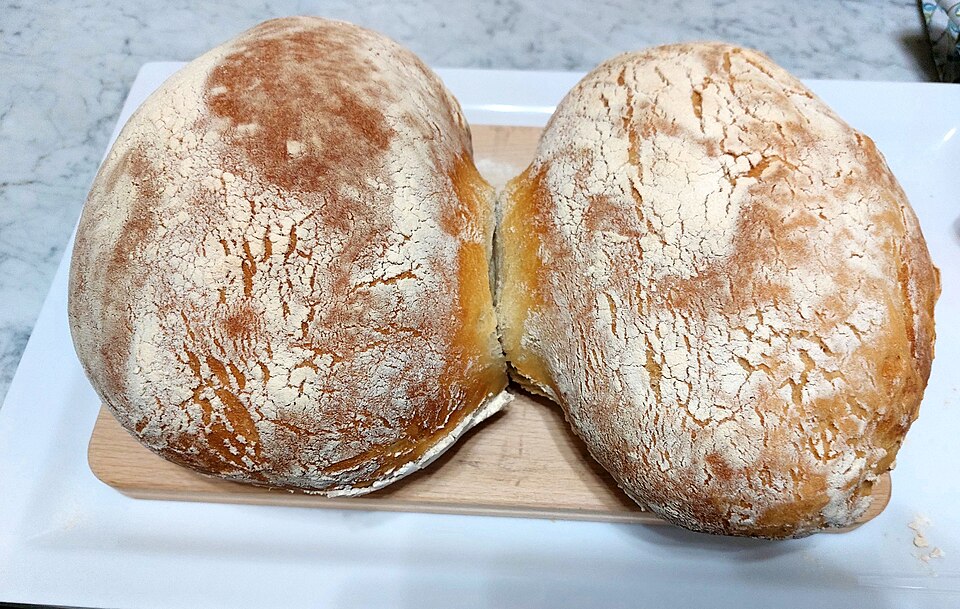
Pane toscano (unsalted Tuscan bread)
Italian · 12 h 5 min · 151 kcal · Vegan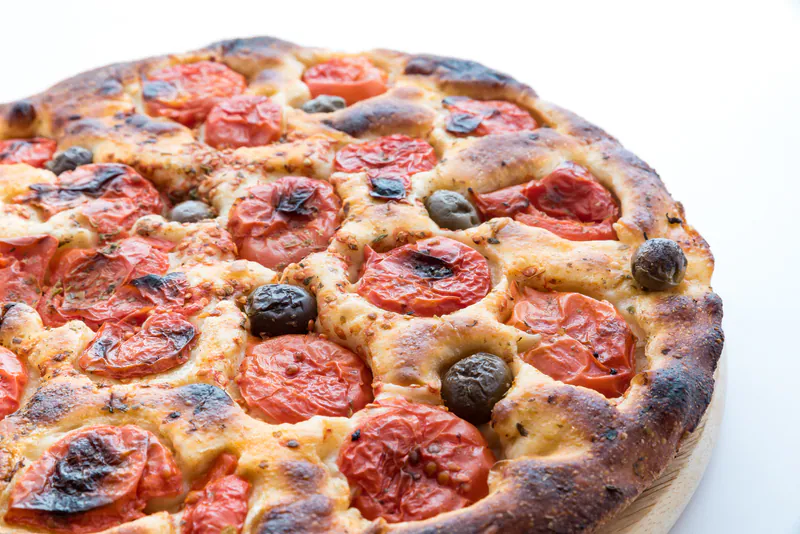
Focaccia barese (Apulian potato focaccia)
Italian · 3 h 50 min · 374 kcal · Vegan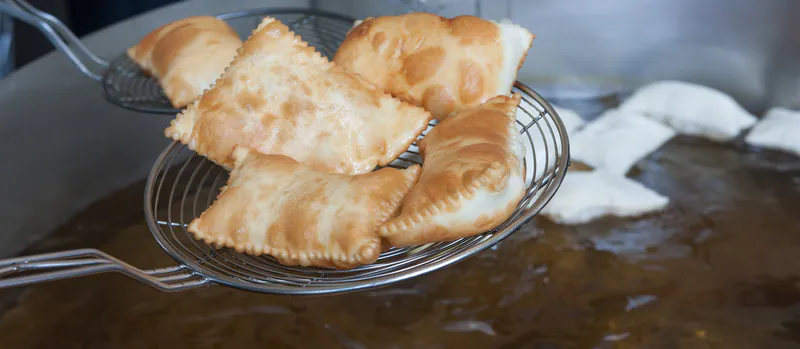
Gnocco fritto (Emilian fried dough puffs)
Italian · 2 h 15 min · 545 kcal