
Elarji (Megrelian cornmeal and sulguni porridge)
Vegetarian
ელარჯი · elarji
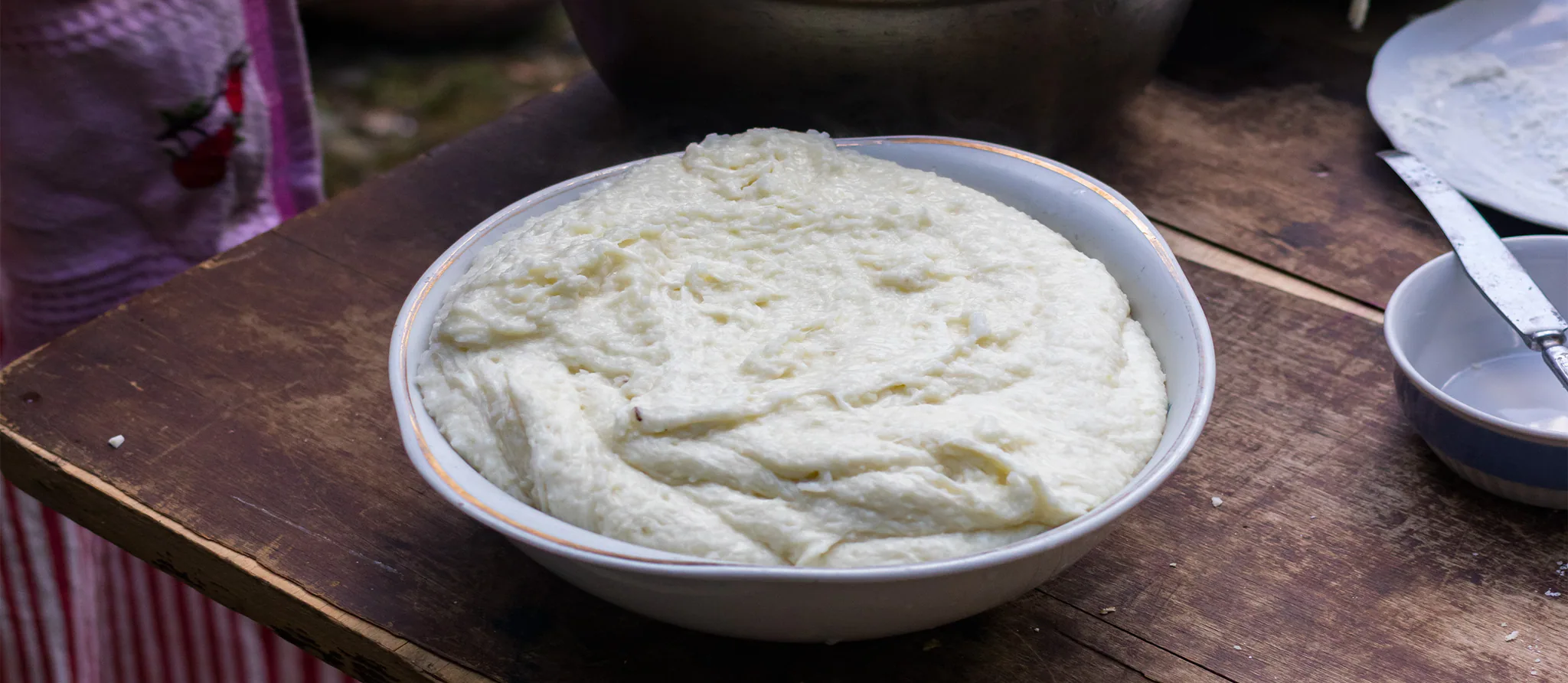
A very thick Georgian cornmeal porridge beaten with masses of grated sulguni until it turns glossy and stretches in long ribbons when lifted. From Samegrelo in western Georgia, it is served hot with a garlicky walnut sauce.
Elarji (Megrelian cornmeal and sulguni porridge) is a Georgian porridge, ready in about 55 minutes and made with cornmeal and sulguni. It serves 4 and is rated intermediate to cook.
- Prep
- 15 min
- Cook
- 40 min
- Total
- 55 min
- Serves
- 4
- Level
- Intermediate
- Calories
- 771
Main ingredients

Ingredients
For the elarji
For the bazhe (walnut sauce)
Method
Bazhe (walnut sauce)
8 minStep 1
Make the bazhe: blend the walnuts (opens in a new tab), garlic (opens in a new tab), coriander, utskho suneli (opens in a new tab), cayenne and salt to a paste, then add the vinegar and enough cold water, a little at a time, to make a pourable sauce like thick cream.
Elarji
40 minStep 2
Bring the 1.2 l water and salt to the boil in a heavy pot. Rain in the coarse cornmeal and fine cornmeal (opens in a new tab) while stirring, then lower the heat.
Food safety: Thick cornmeal spits as it bubbles; use a long spoon and keep your arm covered.
Step 3
Cook for 25–30 minutes, stirring and pressing the porridge against the sides often, until it is very thick and pulls away from the pot in one mass.
- 28 min
- low heat
Step 4
Add the grated sulguni (opens in a new tab) in three batches, beating hard with the wooden spoon (opens in a new tab) after each, until the cheese melts in and the porridge becomes smooth, glossy and elastic. Keep going for 3–5 minutes; it should stretch in long strands when you lift the spoon.
- 6 min
- low heat
It takes real effort — the more you beat it, the stretchier it gets.
Step 5
Serve at once, scooped into bowls, with the bazhe alongside for dipping.
- 1 min
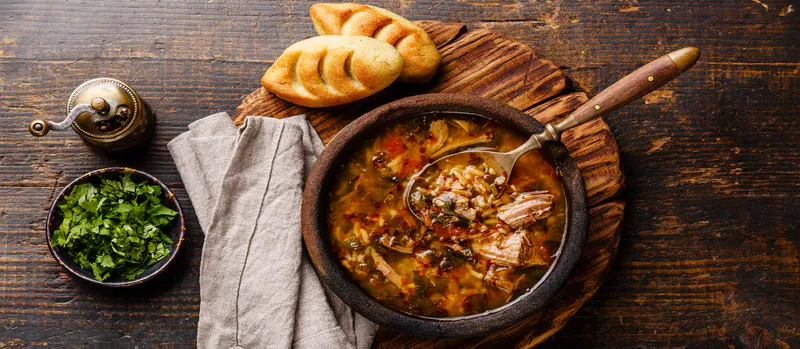
How it looks · Photo: Willians Huerta on Pexels
At a glance
1 · Bazhe (walnut sauce) in a pan
 Walnuts
 Garlic
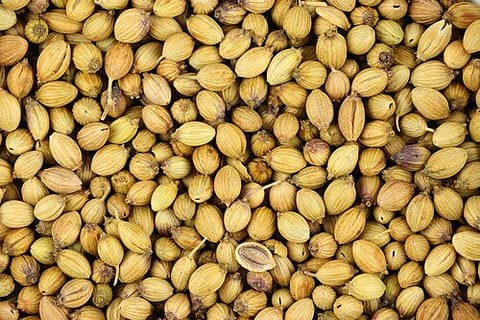 Ground coriander
- Utskho suneli (blue fenugreek)
- Cayenne / chilli powder
 Wine vinegar
 Salt
then bring
2 · Elarji in a pot
 Cornmeal
- Salt
 Sulguni
About this dish
- Origin
- Samegrelo (Mingrelia), Georgia · Well documentedA cheese-enriched form of ghomi, the plain Megrelian corn porridge; sulguni or the young cheese tchkinti is used, whichever is to hand.More food from Georgia
Georgia - Dish
- Lunch · Dinner · Porridge & cereals · Side dishes
- Cooking method
- Boiled, Simmered, Blended
- Taste
- savoury, salty, creamy, nutty
- Diet
- Vegetarian (lacto-ovo) · No gluten ingredients · High-proteinWorked out from the ingredients. How labels work
All labels
Vegetarian (lacto-ovo) · Eggetarian · Lacto-vegetarian · Pescatarian · Flexitarian-friendly · Whole-food focused · No gluten ingredients · Egg-free · No added sugar · Alcohol-free · Pork-free · Beef-free · High-protein - Good for
- Festive & celebration
- Cook more with
- Cornmeal · Sulguni · Walnuts · Garlic · Ground coriander · Utskho suneli (blue fenugreek)
- Techniques
- Boiling · Simmering · Wet grinding · Emulsification
Allergens
- Contains: Milkfrom sulguni
- Contains: Tree nutsfrom walnuts
- May contain: Sulphitesfrom wine vinegar
Based on typical versions of these ingredients and not verified allergen-free. Brands differ and cross-contact happens, so always check labels. For severe allergies, follow your clinician’s advice.
Nutrition
771 kcal per serving
Estimated1 serving ≈ 559 g · recipe makes 4
Where the energy comes from
- Protein 18%
- Carbohydrate 24%
- Fat 58%
| Nutrient | Per serving | Per 100 g* |
|---|---|---|
| Energy | 771 kcal | 138 kcal |
| Protein | 35 g | 6.3 g |
| Carbohydrate | 47.8 g | 8.5 g |
| Net carbohydrate | 41.3 g | 7.4 g |
| Sugars | 1.3 g | 0.2 g |
| Added sugars | 0 g | 0 g |
| Fibre | 6.5 g | 1.2 g |
| Fat | 51.3 g | 9.2 g |
| Saturated fat | 18.2 g | 3.3 g |
| Trans fat | — | — |
| Cholesterol | 89 mg | 16 mg |
| Sodium | 1156 mg | 207 mg |
| Salt equivalent | 2.9 g | 0.5 g |
Vitamins & minerals per serving
- Potassium
- 419 mg
- Calcium
- 653 mg
- Iron
- 3.6 mg
- Magnesium
- 155 mg
- Vitamin A (RAE)
- 210 µg
- Vitamin C
- 2 mg
- Vitamin D
- 0.5 µg
- Vitamin B12
- 2.6 µg
- Folate (DFE)
- 58 µg
How these numbers were made
- Calculated from USDA FoodData Central (SR Legacy) per-100 g values and the listed quantities.
- *Per 100 g of combined raw ingredients; the cooked dish may weigh more or less.
- Sulguni: Mozzarella (FDC 170845) used as a stand-in; sulguni is a brined, stretched-curd Georgian cheese, a little saltier than mozzarella.
- Utskho suneli (blue fenugreek): Fenugreek seed used as a stand-in; utskho suneli is the ground dried pods and seeds of blue fenugreek (Trigonella caerulea), milder and nuttier than common fenugreek.
- “—” means the value isn’t known for enough of the ingredients; it is never zero by default.
- Values are estimates for guidance, not for medical dosing. U.S. Department of Agriculture, Agricultural Research Service. FoodData Central, 2019. fdc.nal.usda.gov.
Good to know
Tips
- Elarji sets as it cools, so get it to the table hot.
Common mistakes
- Adding the cheese before the cornmeal is fully cooked, which leaves a gritty texture.
Serve with
- Serve with bazhe, pickled vegetables and Megrelian kharcho or grilled meat.
Storage
- Best eaten fresh; leftovers keep 2 days in the fridge but lose their stretch.
Reheating
- Slice cold elarji and fry in a little butter until crisp outside and melting within.
Variations
- Ghomi: The plain corn porridge without cheese, served with slices of sulguni pressed into it.
- Elarji with tchkinti: Made with tchkinti, a younger, fresher Megrelian cheese.
Original editorial recipe · FriendsPantry editorial · source: TasteAtlas (dish facts) · Not yet independently reviewed · Added
Recipe DNA
How this dish is built
Built from the recipe’s own sections. Each band’s width is its share of the dish by weight. Choose a component to see what it does.
The body of the dish
For the bazhe (walnut sauce)
- Walnuts150 g
- Garlic3 clove · 12 g
- Ground coriander, ground1 tsp · 1.9 g
- Utskho suneli (blue fenugreek)0.5 tsp · 1.2 g
- Cayenne / chilli powder0.25 tsp · 0.5 g
- Wine vinegar1 tbsp · 15 g
- Water200 ml · 200 g
- Salt0.5 tsp · 3 g
Reviews & corrections
Reviews come from signed-in cooks and appear after a moderator checks them. We never show made-up ratings.
You might also like

Khachapuri adjaruli
 Georgian · 2 h · 957 kcal · Contains egg
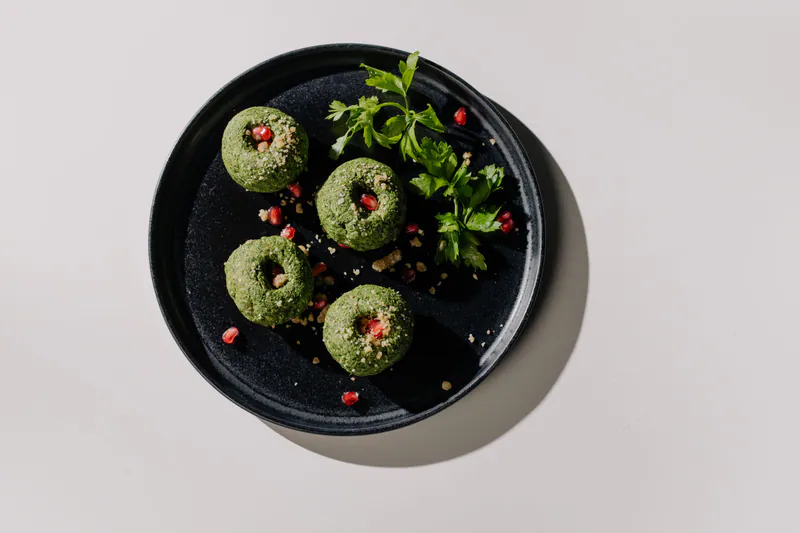
Spinach pkhali
Georgian · 53 min · 155 kcal · Vegan
Badrijani nigvzit
Georgian · 1 h 15 min · 295 kcal · Vegan
Satsivi
Georgian · 4 h 20 min · 494 kcal