
Demi-glace
Non-vegetarian
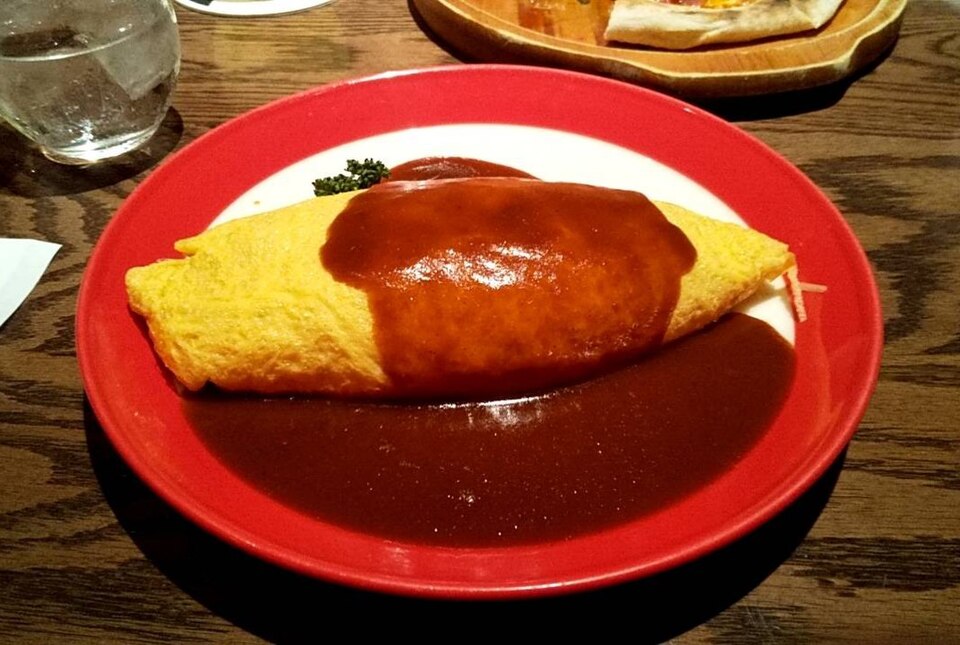
Equal parts espagnole sauce and brown stock reduced slowly by half into a glossy, deeply savoury brown sauce that coats a spoon. The foundation of classical French meat sauces.
Demi-glace is a French sauce from France, ready in about 1 hour 5 minutes and made with espagnole sauce and beef stock. It serves 10 and is rated advanced to cook.
- Prep
- 5 min
- Cook
- 1 h
- Total
- 1 h 5 min
- Serves
- 10
- Level
- Advanced
- Calories
- 34
Main ingredients
Method
Step 1
Combine the espagnole and the brown stock in a heavy saucepan (opens in a new tab) (choose one where the liquid comes about halfway up, so the reduction is easy to see). Add the thyme (opens in a new tab) and bay leaf (opens in a new tab) if using.
Step 2
Bring to the boil over medium heat, then lower to a steady simmer. Reduce uncovered for 45–60 minutes, skimming off the skin and fat with a ladle (opens in a new tab) every 10 minutes and stirring the bottom so it does not catch, until it is reduced by half to about 500 ml.
- 55 min
- medium-low heat
- Ladle (opens in a new tab)
- Wooden spoon (opens in a new tab)
Step 3
Check the consistency: demi-glace is a heavy nappe. It coats the back of a spoon in a glossy, opaque layer, a finger-line holds sharply, and a drop on a cold plate sets almost at once. If it is still thin, keep reducing in 5-minute stages.
Step 4
Strain through a fine sieve (lined with damp muslin for a crystal-clear finish) into a clean container. Use at once, or cool quickly; it sets to a firm jelly when cold.
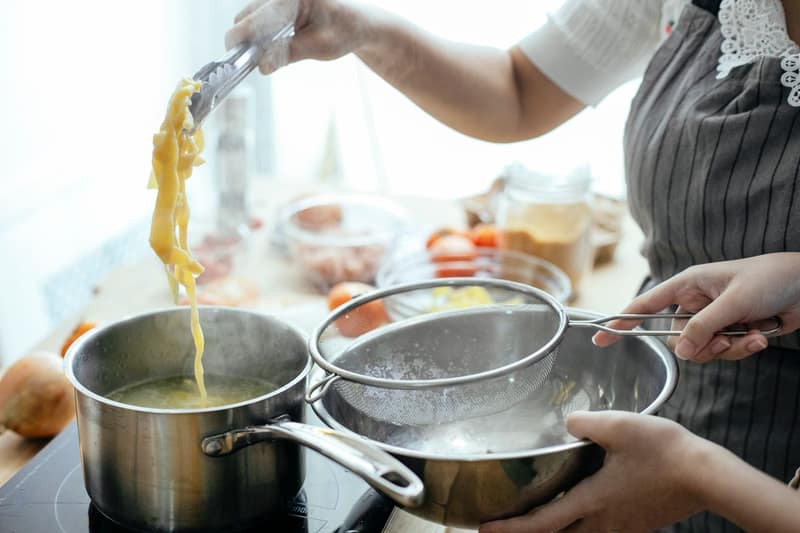
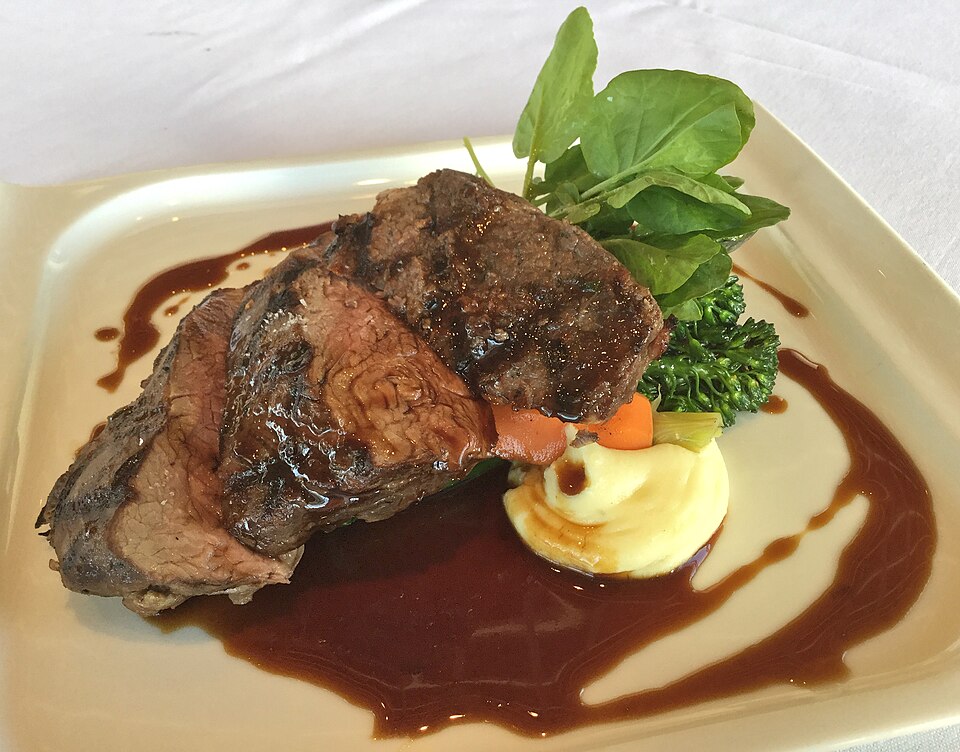
How it looks · Photo: Katerina Holmes on Pexels
About this dish
- Origin
- France · Well documentedDefined by Escoffier (Le Guide culinaire, 1903) as espagnole reduced with an equal volume of brown stock, often finished with Madeira or sherry. Many modern restaurants make a roux-free version by reducing veal stock alone. That version is described under variations.Also popular in United Kingdom, United StatesMore food from France
France - Dish
- Dinner · Sauces
- Cooking method
- Simmered
- Taste
- umami, savoury, rich
- Diet
- No nut ingredients · Low-carbWorked out from the ingredients. How labels work
All labels
Non-vegetarian · Flexitarian-friendly · Egg-free · No nut ingredients · No added sugar · Alcohol-free · Pork-free · Low-carb · Low-fat - Good for
- Make-ahead · Freezer-friendly
- Cook more with
- Beef stock
Allergens
- Contains: Milkfrom espagnole sauce
- Contains: Wheatfrom espagnole sauce
- Contains: Glutenfrom espagnole sauce
- May contain: Celeryfrom espagnole sauce, beef stock
Based on typical versions of these ingredients and not verified allergen-free. Brands differ and cross-contact happens, so always check labels. For severe allergies, follow your clinician’s advice.
Nutrition
34 kcal per serving
Estimated1 serving ≈ 50 g · recipe makes 10
Where the energy comes from
- Protein 32%
- Carbohydrate 35%
- Fat 33%
| Nutrient | Per serving | Per 100 g |
|---|---|---|
| Energy | 34 kcal | 68 kcal |
| Protein | 2.9 g | 5.8 g |
| Carbohydrate | 3.1 g | 6.2 g |
| Net carbohydrate | 2.9 g | 5.7 g |
| Sugars | 0.4 g | 0.8 g |
| Added sugars | 0 g | 0 g |
| Fibre | 0.2 g | 0.4 g |
| Fat | 1.3 g | 2.5 g |
| Saturated fat | 0.6 g | 1.2 g |
| Trans fat | — | — |
| Cholesterol | 2 mg | 3 mg |
| Sodium | 425 mg | 850 mg |
| Salt equivalent | 1.1 g | 2.1 g |
Vitamins & minerals per serving
- Potassium
- 134 mg
- Calcium
- 7 mg
- Iron
- 0.5 mg
- Magnesium
- 5 mg
- Vitamin A (RAE)
- 1 µg
- Vitamin C
- 0 mg
- Vitamin D
- 0 µg
- Vitamin B12
- 0.1 µg
- Folate (DFE)
- 2 µg
How these numbers were made
- Calculated from USDA FoodData Central (SR Legacy) per-100 g values and the listed quantities.
- Optional ingredients are not included: thyme (fresh), bay leaves.
- Espagnole sauce: Canned ready-to-serve beef gravy (FDC 171564) used for espagnole, a roux-thickened brown stock sauce of similar composition.
- “—” means the value isn’t known for enough of the ingredients; it is never zero by default.
- Values are estimates for guidance, not for medical dosing. U.S. Department of Agriculture, Agricultural Research Service. FoodData Central, 2019. fdc.nal.usda.gov.
Good to know
Tips
- For sauce madère or porto, add 50 ml Madeira or port per 500 ml demi-glace off the heat at the end and do not boil again.
- Freeze in ice-cube trays. One or two cubes turn a pan deglazed with wine into a restaurant-style steak sauce.
- Taste before adding salt to anything it goes into. Demi-glace is very concentrated.
Common mistakes
- Reducing at a hard boil, which emulsifies fat back into the sauce and makes it cloudy and greasy.
- Using salted stock, which becomes overpoweringly salty at half volume.
- Taking it too far: past nappe it becomes glace de viande, which is sticky and gluey as a sauce.
Serve with
- Steak au poivre, sauce bordelaise or sauce chasseur for grilled beef.
- Spoon a little under roast fillet of beef, lamb noisettes or duck breast.
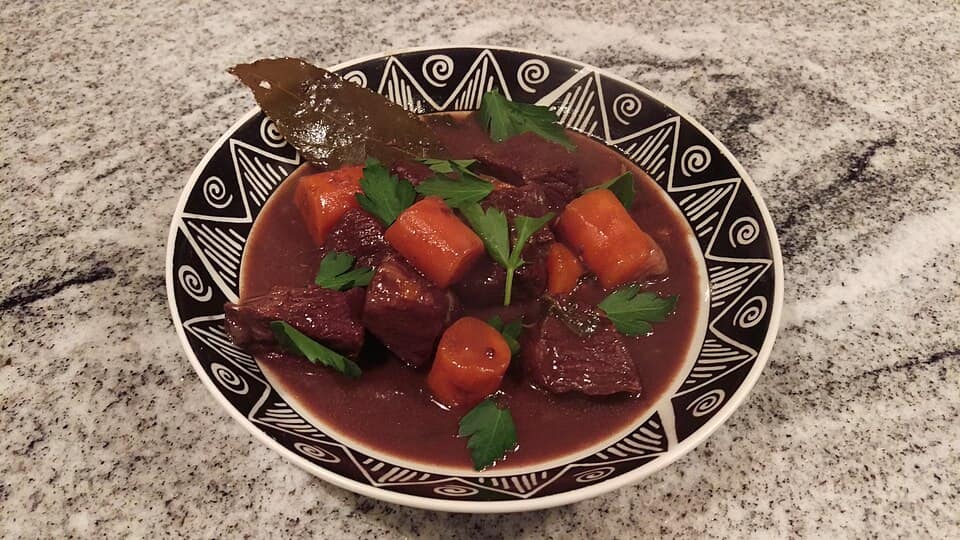
- Enrich the braising liquid of boeuf bourguignon or a beef stew.
Food safety
- Stock-based sauces are a good medium for bacteria. Cool quickly (spread in a shallow container or set the pan in iced water), refrigerate within 2 hours and bring back to a full simmer before serving.
Storage
- Refrigerate up to 1 week; freeze in cubes for up to 3 months.
Reheating
- Melt gently and bring just to a simmer before using.
Variations
- Modern roux-free demi-glace (France): Roasted veal bones and mirepoix are made into stock, then reduced by about 90% until naturally nappe from gelatine alone. It is lighter and clearer, and most restaurants make it this way today.
- Sauce bordelaise (France): Red wine reduced with shallot, thyme and pepper, then simmered with demi-glace and finished with poached bone marrow.
Original editorial recipe · FriendsPantry editorial · Not yet independently reviewed · Added
Goes with
Recipe DNA
How this dish is built
Grouped by each ingredient’s role in the dish. Each band’s width is its share of the dish by weight. Choose a component to see what it does.
The spice and seasoning backbone
Spices, masalas & pastes
- Bay leaves (optional)1 leaf · 0.2 g
Make it milder, swap ingredients for your diet, change the batch size or thickness — the original stays as it is.
Customise in Sauce & DrizzleReviews & corrections
Reviews come from signed-in cooks and appear after a moderator checks them. We never show made-up ratings.
You might also like
Espagnole sauce
 French · 2 h 20 min · 91 kcal
Red wine pan sauce
French · 15 min · 108 kcal
Béarnaise sauce
French · 25 min · 251 kcal · Contains egg
French onion soup
French · 1 h 45 min · 529 kcal