
Beef Wellington
Non-vegetarian
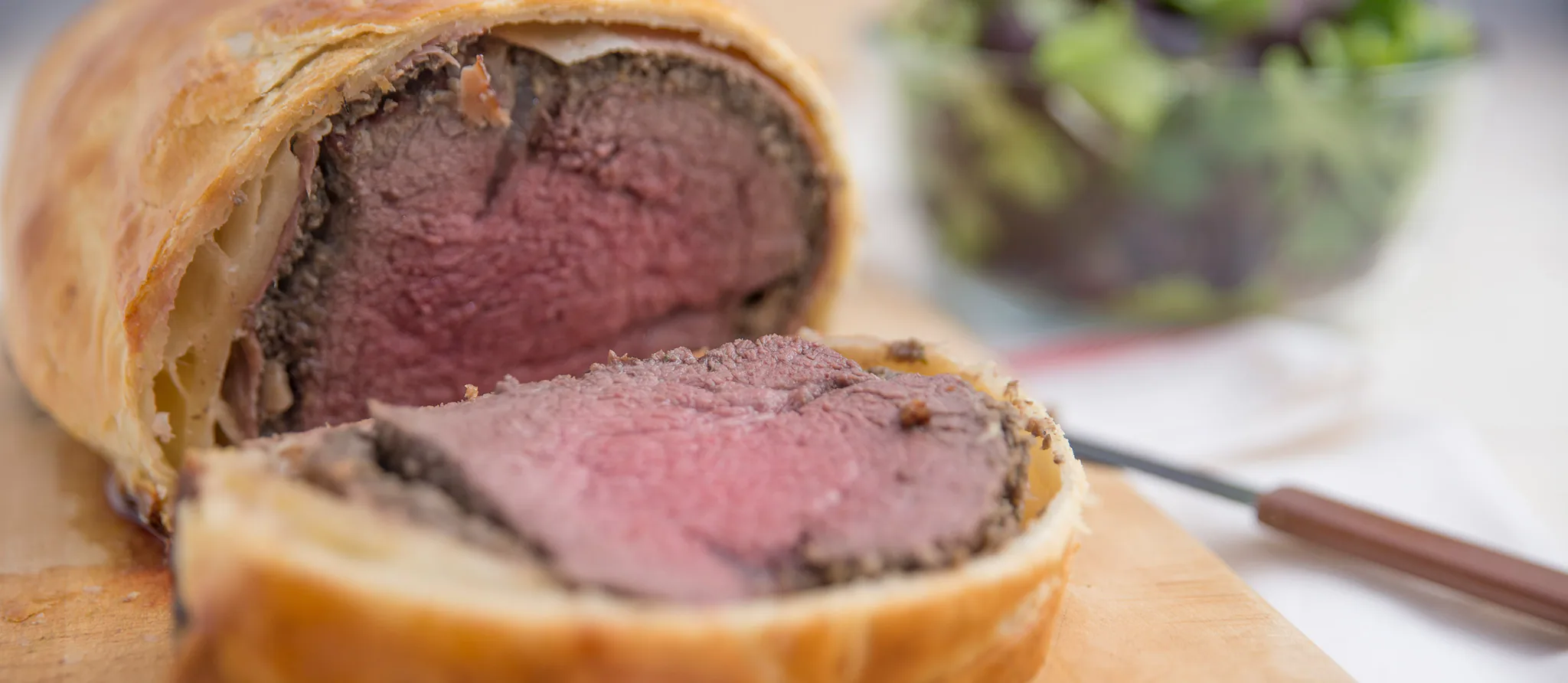
A whole beef fillet seared, brushed with mustard and wrapped in a layer of mushroom duxelles and ham inside golden puff pastry, then roasted until the meat is rosy pink. A showpiece for Christmas and special dinners, sliced at the table and served with a rich wine sauce.
Beef Wellington is a British main course, ready in about 3 hours 15 minutes and made with beef tenderloin, mushrooms and all-butter puff pastry. It serves 6 and is rated advanced to cook.
- Prep
- 50 min
- Cook
- 1 h 15 min
- Rest
- 1 h 10 min
- Total
- 3 h 15 min
- Serves
- 6
- Level
- Advanced
- Calories
- 938
Main ingredients
Ingredients
For the beef
For the duxelles
To wrap
For the sauce
Equipment
- Cast-iron skillet (opens in a new tab)
- Frying pan / skillet (opens in a new tab)
- Food processor (opens in a new tab)
- Rolling pin (opens in a new tab)
- Pastry brush (opens in a new tab)
- Baking tray / sheet (opens in a new tab)
- Food thermometer (opens in a new tab)
- Saucepan (opens in a new tab)
- Chef's knife (opens in a new tab)
- Oven (opens in a new tab)
Method
Beef
10 minStep 1
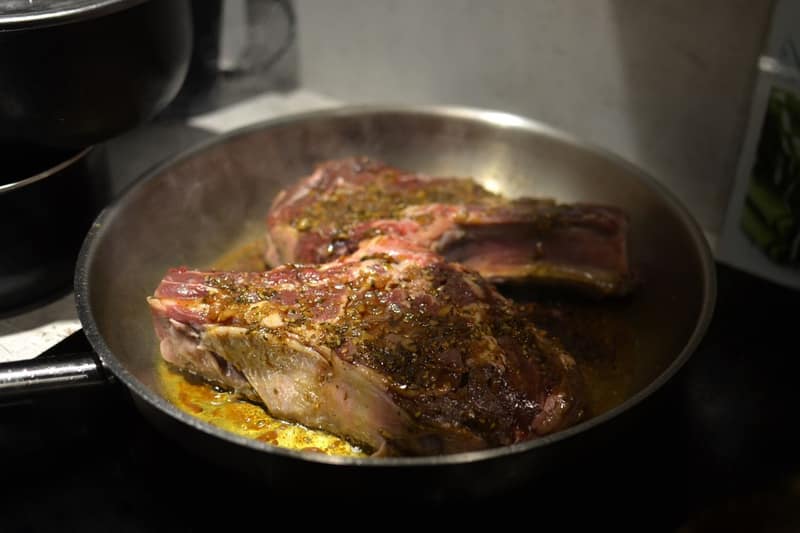
Pat the fillet dry and season with salt and pepper (opens in a new tab). Sear in the hot oil in a heavy pan over high heat, turning, until browned all over, about 4 minutes in total. Leave to cool for 5 minutes, remove the string and brush all over with the mustard.
- 10 min
- high heat
- Cast-iron skillet (opens in a new tab)
How it looks · Photo: Skylar Kang on Pexels
Duxelles
20 minStep 2
For the duxelles, pulse the mushrooms (opens in a new tab) in a food processor (opens in a new tab) until very fine if you have not chopped them by hand. Melt the butter (opens in a new tab) in a wide pan and soften the shallot (opens in a new tab) and garlic (opens in a new tab) for 3 minutes. Add the mushrooms and thyme (opens in a new tab) and cook over medium-high heat, stirring, until all their liquid has evaporated and they start to stick, 12–15 minutes. Add the wine and cook until dry again, then stir in the parsley (opens in a new tab) and season. Spread on a plate to cool completely.
- 20 min
- medium-high heat
- Food processor (opens in a new tab)
- Frying pan / skillet (opens in a new tab)
The duxelles must be dry, or it will turn the pastry soggy.
To wrap
1 h 5 minStep 3
Overlap the prosciutto slices on a large sheet of cling film to make a rectangle big enough to wrap the beef. Spread the cooled duxelles evenly over it. Lay the beef along one edge and use the film to roll the ham and duxelles tightly around it. Twist the ends to make a firm log and chill for 20 minutes.
- 10 min
Step 4
Roll out the pastry on a lightly floured surface to a rectangle about 3 mm thick and large enough to wrap the beef. Unwrap the beef and place it in the centre. Brush the pastry edges with egg yolk (opens in a new tab), fold over to enclose it with a small overlap, trim the excess and seal the ends. Turn seam-side down onto a lined baking tray, brush all over with egg yolk and chill for 30 minutes.
- 15 min
- Rolling pin (opens in a new tab)
- Pastry brush (opens in a new tab)
- Baking tray / sheet (opens in a new tab)

How it looks · Photo: Katerina Holmes on Pexels Step 5
Heat the oven (opens in a new tab) to 200 °C (fan 180 °C). Brush with a second coat of egg yolk (opens in a new tab), score a light lattice with the back of a knife and sprinkle with a little salt. Bake for 35–40 minutes, until the pastry is deep golden and a thermometer in the centre of the beef reads 50–52 °C for medium-rare.
- 40 min
- 200°C · fan 180 °C
- Oven (opens in a new tab)
- Food thermometer (opens in a new tab)

How it looks · Photo: Klaus Nielsen on Pexels Step 6
Rest the Wellington for 15–20 minutes before slicing; the temperature will rise a few degrees more.
Sauce
18 minStep 7
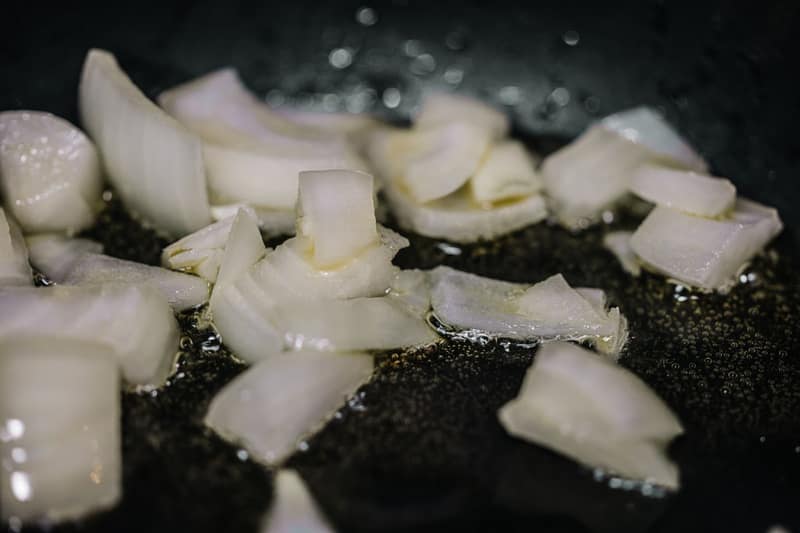
Meanwhile, soften the shallot (opens in a new tab) in the beef-searing pan, add the port (opens in a new tab) and boil until reduced by half. Add the stock and boil until reduced to about 200 ml and slightly syrupy. Off the heat, whisk in the cold butter (opens in a new tab) and season.
- 15 min
- high heat
- Saucepan (opens in a new tab)
How it looks · Photo: Magda Ehlers on Pexels Step 8
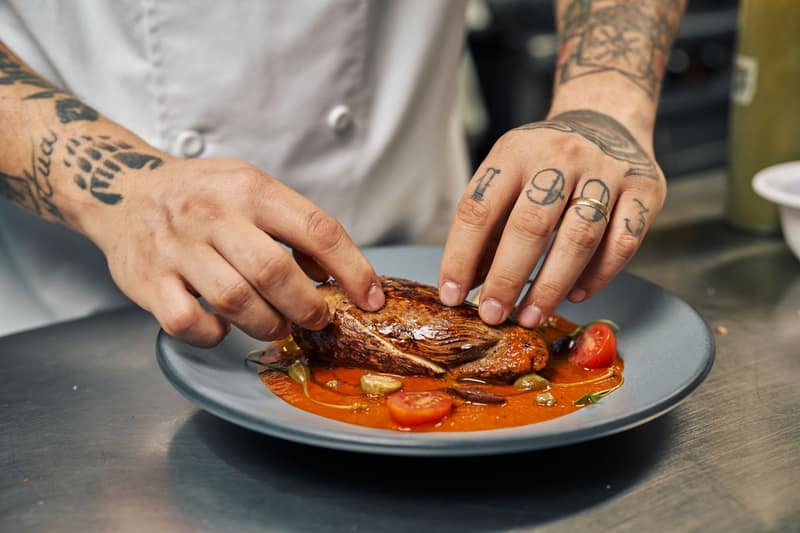
Cut into thick slices with a serrated or very sharp knife and serve with the sauce.
How it looks · Photo: Willians Huerta on Pexels
At a glance
1 · Beef in a pan
 Beef tenderloin
 Olive oil
 Salt
 Black pepper
 Prepared mustard
then pulse
2 · Duxelles in a pan
 Mushrooms
 Butter
 Shallot
 Garlic
 Thyme (fresh)
 Dry white wine
 Parsley
then overlap
3 · To wrap in a bowl
 Prosciutto / dry-cured ham
- All-butter puff pastry
 All-purpose flour
 Egg yolk
then soften
4 · Sauce in a pan
- Shallot
 Port wine
 Beef stock
- Butter
About this dish
- Origin
- England, United Kingdom · Origin disputedOften linked to Arthur Wellesley, the first Duke of Wellington, though no recipe under that name appears until the 20th century. Meat baked in pastry is an old French and English idea; the dish became a dinner-party classic in the 1960s and 70s.Also popular in United States, IrelandMore food from United Kingdom
United Kingdom - Dish
- Dinner · Main courses
- Cooking method
- Pan-fried, Sautéed, Oven-baked, Simmered
- Taste
- rich, savoury, earthy, buttery
- Diet
- No nut ingredients · High-proteinWorked out from the ingredients. How labels work
All labels
Non-vegetarian · No nut ingredients · No added sugar · High-protein - Good for
- Festive & celebration · Make-ahead
- Cook more with
- Beef tenderloin · Mushrooms · All-butter puff pastry · Prepared mustard · Butter · Shallot
- Techniques
- Baking · Searing · Pan-frying · Sautéing · Boiling
Allergens
- Contains: Milkfrom butter, all-butter puff pastry
- Contains: Eggsfrom egg yolk
- Contains: Wheatfrom all-butter puff pastry, all-purpose flour
- Contains: Glutenfrom all-butter puff pastry, all-purpose flour
- Contains: Mustardfrom prepared mustard
- May contain: Celeryfrom beef stock
- Contains: Sulphitesfrom prepared mustard, dry white wine, port wine
Based on typical versions of these ingredients and not verified allergen-free. Brands differ and cross-contact happens, so always check labels. For severe allergies, follow your clinician’s advice.
Nutrition
938 kcal per serving
Estimated1 serving ≈ 486 g · recipe makes 6
Where the energy comes from
- Protein 23%
- Carbohydrate 22%
- Fat 55%
| Nutrient | Per serving | Per 100 g* |
|---|---|---|
| Energy | 938 kcal | 193 kcal |
| Protein | 52.9 g | 10.9 g |
| Carbohydrate | 48.8 g | 10.1 g |
| Net carbohydrate | 45.9 g | 9.4 g |
| Sugars | 5.9 g | 1.2 g |
| Added sugars | 0 g | 0 g |
| Fibre | 3 g | 0.6 g |
| Fat | 55.1 g | 11.3 g |
| Saturated fat | 16.9 g | 3.5 g |
| Trans fat | — | — |
| Cholesterol | 190 mg | 39 mg |
| Sodium | 1222 mg | 252 mg |
| Salt equivalent | 3.1 g | 0.6 g |
Vitamins & minerals per serving
- Potassium
- 1184 mg
- Calcium
- 86 mg
- Iron
- 6.3 mg
- Magnesium
- 78 mg
- Vitamin A (RAE)
- 75 µg
- Vitamin C
- 15 mg
- Vitamin D
- —
- Vitamin B12
- 2.2 µg
- Folate (DFE)
- 159 µg
How these numbers were made
- Calculated from USDA FoodData Central (SR Legacy) per-100 g values and the listed quantities.
- *Per 100 g of combined raw ingredients; the cooked dish may weigh more or less.
- Beef tenderloin: Top sirloin steak, lean only (FDC 174055) used as a stand-in; centre-cut beef tenderloin (fillet) is a similarly lean muscle.
- Prosciutto / dry-cured ham: Cured ham, lean and fat, unheated (FDC 167875) used as a stand-in for air-dried prosciutto/jamón; real dry-cured ham is drier and saltier.
- All-butter puff pastry: Frozen puff pastry (FDC 172790). Shop-bought puff pastry varies; some brands use vegetable fat.
- Port wine: Sweet dessert wine (FDC 173176) used for port, a sweet fortified wine of similar sugar and alcohol content.
- “—” means the value isn’t known for enough of the ingredients; it is never zero by default.
- Values are estimates for guidance, not for medical dosing. U.S. Department of Agriculture, Agricultural Research Service. FoodData Central, 2019. fdc.nal.usda.gov.
Good to know
Tips
- You can wrap the beef in pastry up to 12 hours ahead and keep it chilled; add 5 minutes to the baking time.
- A layer of thin pancakes between the ham and pastry absorbs juices and keeps the base crisp.
Common mistakes
- Wrapping the beef while it or the duxelles is still warm, which melts the butter in the pastry.
- Cutting it straight from the oven, which floods the board with juices and leaves the pastry soggy.
Serve with
- Serve with roast potatoes, buttered green beans or glazed carrots.
- A mushroom or red wine sauce works if you have no Madeira.
Food safety
- Whole cuts of beef can safely be served pink in the centre, as surface bacteria are killed by searing; minced or rolled meats cannot.
Storage
- Leftovers keep 2 days refrigerated, though the pastry softens.
Reheating
- Reheat slices in a 180 °C oven for 10–12 minutes; the beef will cook further.
Variations
- Classic Wellington with pâté: A layer of foie gras or chicken-liver pâté is spread over the beef before the duxelles, as in many 1960s recipes.
- Individual Wellingtons: Fillet steaks wrapped individually; they bake in about 20 minutes.
- Mushroom Wellington: A vegetarian version with a core of whole portobello mushrooms, spinach and chestnuts.
Original editorial recipe · FriendsPantry editorial · source: TasteAtlas (dish facts) · Not yet independently reviewed · Added
Sauces, chutneys & dips for this dish
Recipe DNA
How this dish is built
Built from the recipe’s own sections. Each band’s width is its share of the dish by weight. Choose a component to see what it does.
What the dish is built around
For the beef
- Beef tenderloin, centre-cut fillet, trimmed of sinew and tied1000 g
- Olive oil2 tbsp · 27 g
- Salt1 tsp · 6 g
- Black pepper0.5 tsp · 1.2 g
- Prepared mustard2 tbsp · 31 g
Reviews & corrections
Reviews come from signed-in cooks and appear after a moderator checks them. We never show made-up ratings.
You might also like
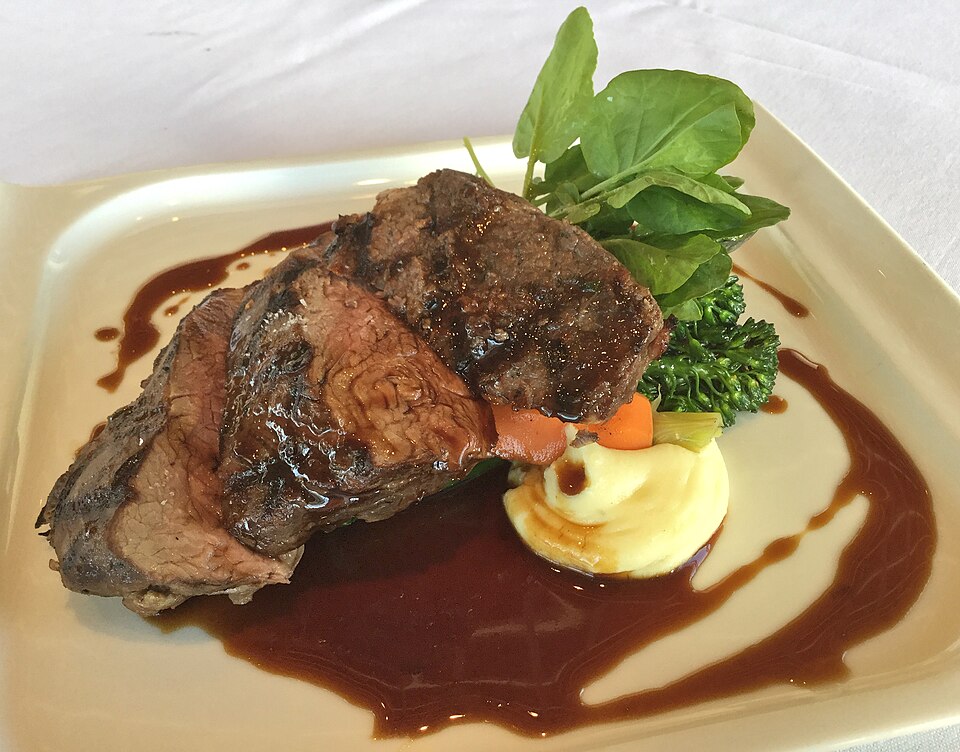
Red wine pan sauce
 French · 15 min · 108 kcal
Creamy Mashed Potatoes
International · 32 min · 306 kcal · Vegetarian
Boeuf bourguignon
French · 4 h · 625 kcal
Steak and ale pie
 British · 4 h 55 min · 898 kcal