
Bakpia pathok (Yogyakarta mung bean pastries)
Vegetarian
Bakpia pathok
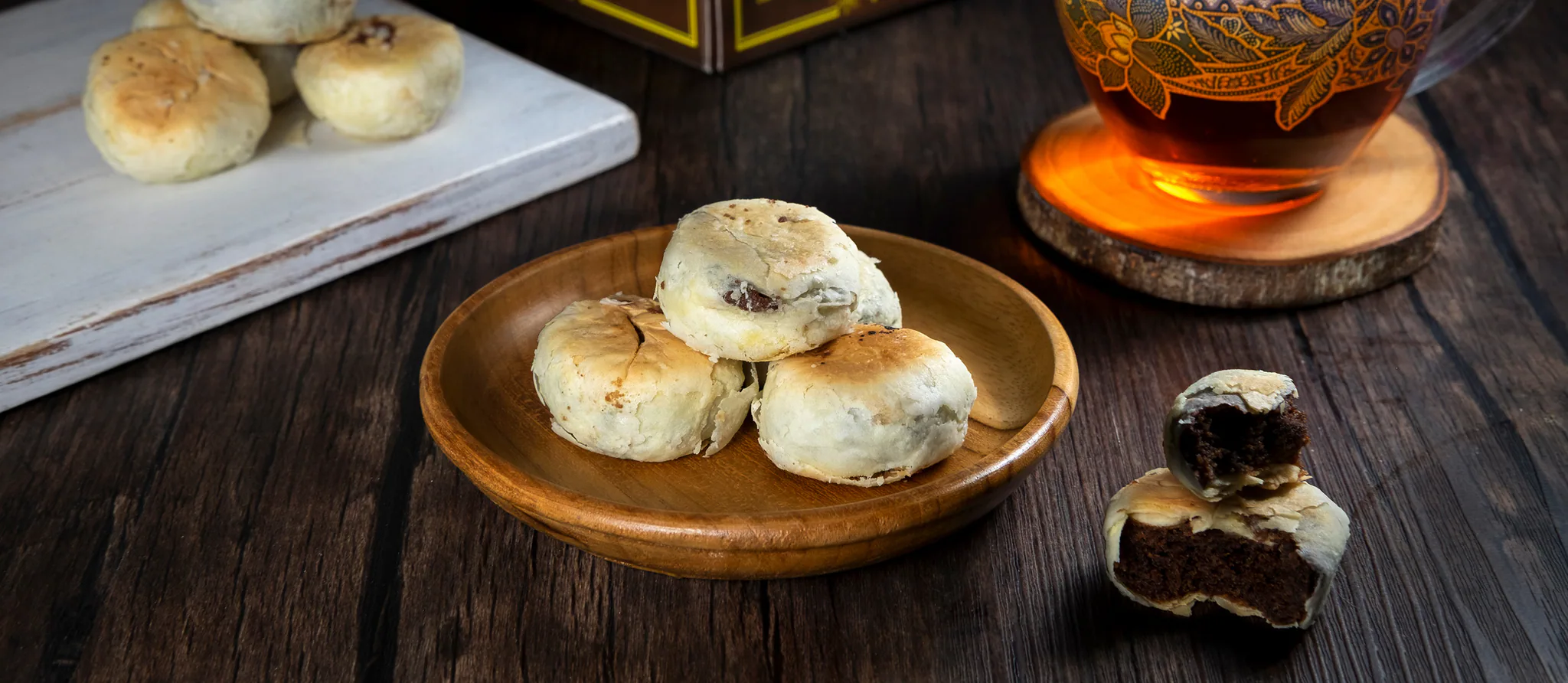
Small, round, slightly flattened pastries with thin, flaky layers wrapped around a sweet, dense mung bean paste, baked until spotted golden. Yogyakarta's best-known edible souvenir, descended from Chinese-Indonesian flaky pastries.
Bakpia pathok (Yogyakarta mung bean pastries) is an Indonesian pastry, ready in about 2 hours 30 minutes and made with mung beans, all-purpose flour and neutral vegetable oil. It serves 20 and is rated intermediate to cook.
- Prep
- 1 h
- Cook
- 1 h
- Rest
- 30 min
- Total
- 2 h 30 min
- Serves
- 20
- Level
- Intermediate
- Calories
- 190
Plus 4 hours soaking the beans.
Main ingredients
Ingredients
For the filling
For the water dough
For the oil dough
Method
Filling
50 minStep 1
Drain the soaked mung beans (opens in a new tab) and steam them with the pandan leaves (opens in a new tab) for 25–30 minutes until completely soft. Discard the pandan and blend the beans to a smooth paste.
Step 2
Cook the paste with 150 g sugar (opens in a new tab), 3 tbsp oil and the salt in a non-stick pan over low heat, stirring, until it is thick enough to roll into balls and no longer sticks to the pan, about 15 minutes. Cool, then roll into 20 balls of about 20 g.
- 20 min
- low heat
- Frying pan / skillet (opens in a new tab)
Water dough
1 h 10 minStep 3
For the water dough, mix 200 g flour with 20 g sugar (opens in a new tab), salt, 50 ml oil and enough water to make a soft, smooth dough. For the oil dough, rub 100 g flour with 50 ml oil to a soft paste. Rest both, covered, for 30 minutes.
- 10 min
Step 4
Divide both doughs into 20 pieces. Flatten each water-dough piece, wrap it around a piece of oil dough and seal. Roll each into a long oval, roll it up like a Swiss roll, turn 90°, roll out again and roll up once more.
Keep the pieces covered as you work so they do not dry out.
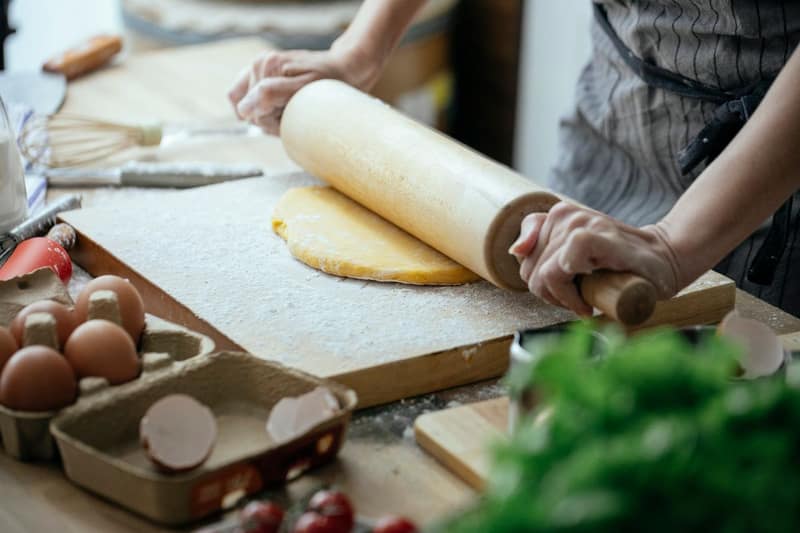
How it looks · Photo: Katerina Holmes on Pexels Step 5
Heat the oven (opens in a new tab) to 200 °C. Flatten each coil into a 8 cm round, place a filling ball in the centre, wrap and pinch shut. Set seam-down on a lined tray and flatten slightly into thick discs.
- 15 min
- 200°C
- Baking tray / sheet (opens in a new tab)
Step 6
Bake for 10 minutes, turn each pastry over, then bake another 10–15 minutes until both sides are spotted golden brown.
- 25 min
- 200°C
- Oven (opens in a new tab)
At a glance
1 · Filling in a bowl
 Mung beans
 Sugar
 Neutral vegetable oil
 Salt
 Pandan leaves
then mix
2 · Water dough in a bowl
 All-purpose flour
- Sugar
- Salt
- Neutral vegetable oil
About this dish
- Origin
- Pathok, Yogyakarta, Indonesia · Well documentedNamed after the Pathok neighbourhood of Yogyakarta where Chinese-Indonesian bakers began making them in the mid-20th century; related to the Fujianese tou sar pia and Filipino hopia.More food from Indonesia
Indonesia - Dish
- Snack · Pastries · Sweets & confectionery
- Cooking method
- Steamed, Oven-baked
- Taste
- sweet, nutty, mild
- Diet
- Vegan · Dairy-free · No nut ingredientsWorked out from the ingredients. How labels work
All labels
Vegan · Plant-based · Vegetarian (lacto-ovo) · Eggetarian · Lacto-vegetarian · Ovo-vegetarian · Pescatarian · Flexitarian-friendly · Dairy-free · Egg-free · No nut ingredients · Alcohol-free · Pork-free · Beef-free · DASH-style - Good for
- Portable / lunchbox · Make-ahead
- Cook more with
- Mung beans · All-purpose flour · Sugar
Allergens
- Contains: Wheatfrom all-purpose flour
- Contains: Glutenfrom all-purpose flour
Based on typical versions of these ingredients and not verified allergen-free. Brands differ and cross-contact happens, so always check labels. For severe allergies, follow your clinician’s advice.
Nutrition
190 kcal per serving
Calculated1 serving ≈ 47 g · recipe makes 20
Where the energy comes from
- Protein 9%
- Carbohydrate 58%
- Fat 32%
| Nutrient | Per serving | Per 100 g* |
|---|---|---|
| Energy | 190 kcal | 401 kcal |
| Protein | 4.5 g | 9.6 g |
| Carbohydrate | 27.8 g | 58.7 g |
| Net carbohydrate | 25.3 g | 53.6 g |
| Sugars | 9.3 g | 19.8 g |
| Added sugars | 8.5 g | 18 g |
| Fibre | 2.4 g | 5.2 g |
| Fat | 6.9 g | 14.7 g |
| Saturated fat | 0.6 g | 1.2 g |
| Trans fat | — | — |
| Cholesterol | 0 mg | 0 mg |
| Sodium | 61 mg | 128 mg |
| Salt equivalent | 0.2 g | 0.3 g |
Vitamins & minerals per serving
- Potassium
- 172 mg
- Calcium
- 19 mg
- Iron
- 1.5 mg
- Magnesium
- 27 mg
- Vitamin A (RAE)
- 1 µg
- Vitamin C
- 1 mg
- Vitamin D
- 0 µg
- Vitamin B12
- 0 µg
- Folate (DFE)
- 122 µg
How these numbers were made
- Calculated from USDA FoodData Central (SR Legacy) per-100 g values and the listed quantities.
- *Per 100 g of combined raw ingredients; the cooked dish may weigh more or less.
- Optional ingredients are not included: pandan leaves.
- “—” means the value isn’t known for enough of the ingredients; it is never zero by default.
- Values are estimates for guidance, not for medical dosing. U.S. Department of Agriculture, Agricultural Research Service. FoodData Central, 2019. fdc.nal.usda.gov.
Good to know
Tips
- Turning the pastries halfway gives the characteristic flat tops with brown speckles on both sides.
Common mistakes
- Filling that is too soft — it leaks during baking. It should be firm enough to roll.

Storage
- Keeps 4 days in an airtight container at room temperature, or 1 month frozen.
Reheating
- Warm in a 160 °C oven for 5 minutes to re-crisp.
Variations
- Bakpia keju: Filled with sweetened cheese, one of the most popular modern versions.
- Bakpia kumbu hitam: Filled with sweet black (adzuki-type) bean paste.
- Bakpia basah: A softer, moist version eaten fresh.
Original editorial recipe · FriendsPantry editorial · source: TasteAtlas (dish facts) · Not yet independently reviewed · Added
Recipe DNA
How this dish is built
Built from the recipe’s own sections. Each band’s width is its share of the dish by weight. Choose a component to see what it does.
Reviews & corrections
Reviews come from signed-in cooks and appear after a moderator checks them. We never show made-up ratings.
You might also like
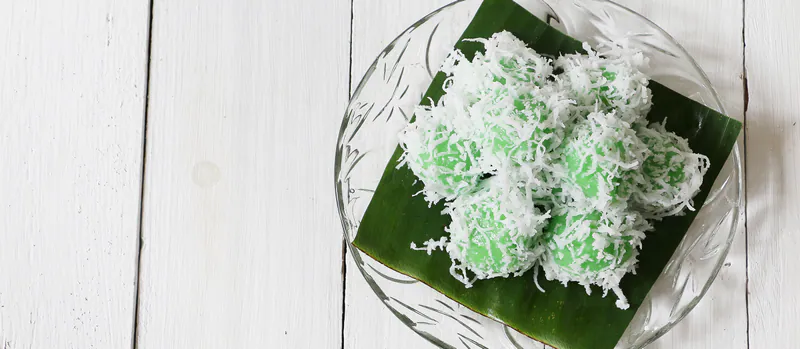
Klepon (pandan rice balls with palm sugar)
 Indonesian · 1 h · 274 kcal · Vegan
Martabak manis
Indonesian · 1 h 25 min · 363 kcal · Contains egg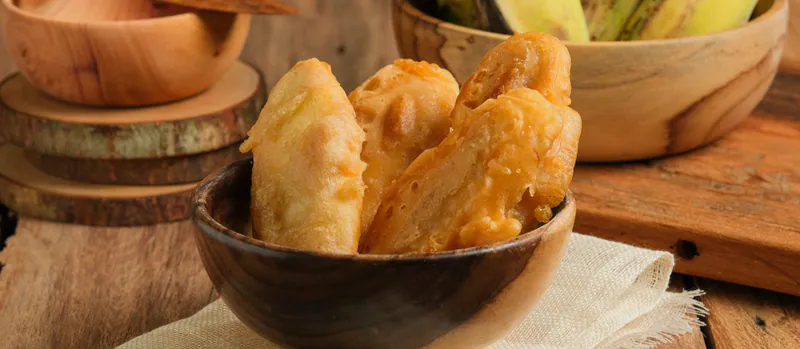
Pisang goreng (Indonesian banana fritters)
Indonesian · 25 min · 387 kcal · Vegan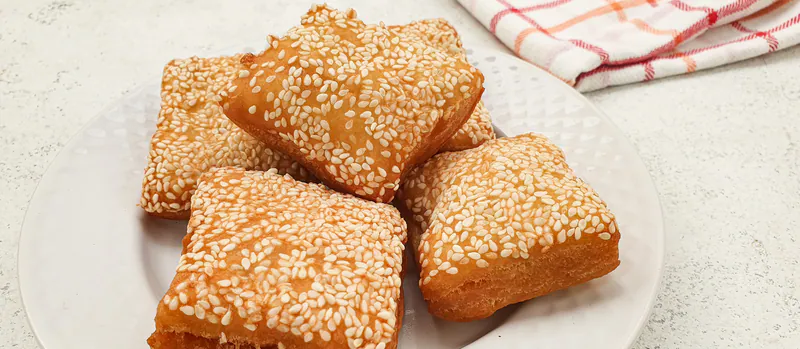
Odading (Bandung fried sweet bread)
Indonesian · 2 h 15 min · 375 kcal · Contains egg